


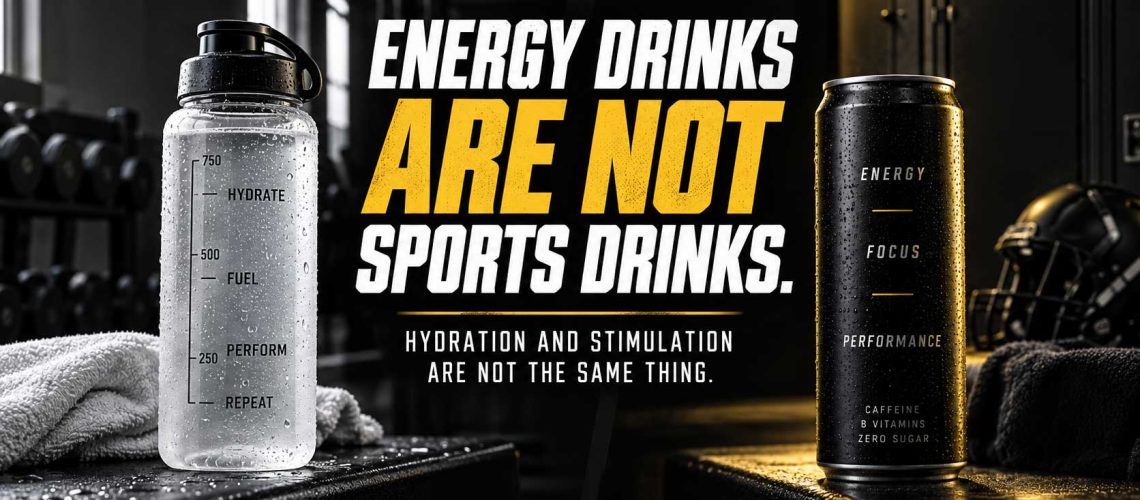

Energy drinks are not sports drinks. They are stimulant products, usually containing caffeine plus ingredients such as guarana, taurine, or herbal extracts, and they do not belong at high school practices, games, lifts, camps, team meetings, or school-sponsored travel (American Academy of Pediatrics, 2011; NFHS Sports Medicine Advisory Committee, 2024).
That distinction matters because energy-drink packaging often borrows the visual language of sports performance. A brightly colored can promising “energy,” “focus,” or “performance” can look like another hydration option to a teenager—even though the product serves a fundamentally different purpose.
Some school systems and state athletic organizations already restrict energy drinks, and Delaware enacted a 2026 law prohibiting their sale at public middle and high schools during the school day and school-sponsored activities (NFHS Sports Medicine Advisory Committee, 2024, WBOC, 2026). Even so, schools do not need to wait for statewide legislation. An athletic department can adopt a clear, educational, and enforceable rule now.
Why a Policy Is Needed
Energy drinks affect the cardiovascular system
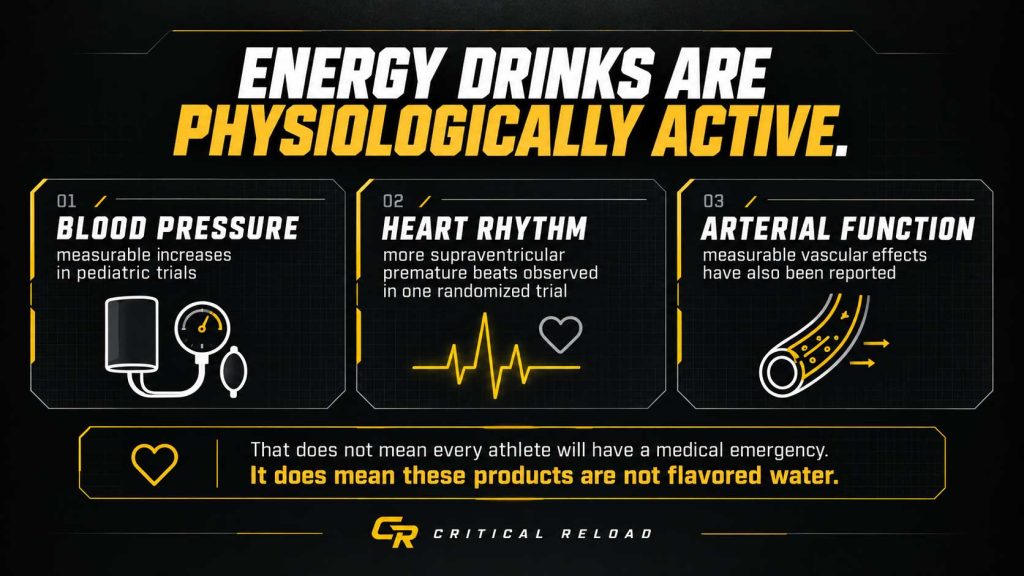
Controlled pediatric trials show that energy drinks can produce measurable cardiovascular changes even in healthy minors. In a randomized crossover trial involving 27 children and adolescents, a weight-adjusted energy drink increased mean systolic blood pressure by as much as 5.23 mmHg and mean diastolic blood pressure by as much as 3.29 mmHg compared with placebo (Oberhoffer et al., 2022).
A related randomized trial found significantly more supraventricular extrasystoles—premature beats arising in the heart’s upper chambers—after energy-drink consumption than after placebo. The investigators did not observe malignant ventricular arrhythmias, and the study was too small to determine the risk of rare serious events (Mandilaras et al., 2022).
Another randomized pediatric trial used 24-hour ambulatory monitoring and found significantly higher systolic and diastolic blood pressure after a single energy-drink dose than after placebo (Oberhoffer et al., 2023). Taken together, these studies do not mean every athlete who consumes an energy drink will have a medical emergency, but they do show that the products are physiologically active and should not be treated like flavored water.
Serious events are uncommon but plausible
A literature review identified 18 published pediatric cases involving confirmed energy-drink consumption. Of those cases, 45% involved the cardiovascular system and 33% involved the neuropsychological system; many cases also involved additional triggers or preexisting medical conditions (Li et al., 2023).
Case reports cannot establish how frequently these events occur or prove that the drink caused every outcome. Even so, they remain useful for identifying potentially vulnerable situations, including underlying heart conditions, simultaneous stimulant exposure, medication use, intense exercise, and unusually high intake.
Poison-center surveillance also shows that energy-drink exposures can produce neurologic, gastrointestinal, and cardiovascular symptoms in children and young adults, although many reported pediatric exposures involve very young children rather than student-athletes (Lipshultz et al., 2025).
Sleep and recovery are part of performance
A 2024 systematic review covering 57 studies found that energy-drink consumption among children and young people was associated with short sleep duration, poor sleep quality, low academic performance, psychological distress, substance use, and other adverse outcomes (Ajibo et al., 2024). Most of this evidence is based on observation, so it cannot prove that energy drinks directly caused every outcome. Even so, the pattern matters.
State that limitation clearly, but it does not make the pattern irrelevant. For an athlete, a stimulant used to compensate for fatigue can contribute to later sleep and greater next-day tiredness, potentially strengthening a cycle of inadequate recovery and repeated stimulant use.
Performance benefits do not settle the issue
Caffeine can improve selected performance outcomes under some conditions, but evidence specific to adolescent athletes remains limited. A 2026 systematic review and meta-analysis found a small favorable average effect on selected physical-performance tasks, but the benefit was uncertain, adverse-event reporting was inconsistent, and the authors concluded that current evidence does not support routine caffeine use in youth sport (Liu et al., 2026).
Importantly, controlled caffeine research differs from research on commercial energy drinks. Energy drinks may combine caffeine with multiple bioactive ingredients, and products vary in serving size, formulation, labeling, and intended use. So a small performance benefit from a controlled caffeine dose does not mean an energy drink is necessary, appropriate, or safe for a high-school athlete.
What Health Experts Say
The American Academy of Pediatrics has stated that caffeine and other stimulant substances contained in energy drinks have no place in the diets of children and adolescents. Its clinical report also stresses that sports drinks and energy drinks are significantly different products and should not be used interchangeably (American Academy of Pediatrics, 2011).
In 2025, an expert panel convened by Healthy Eating Research—with representatives from the American Academy of Pediatrics, the Academy of Nutrition and Dietetics, the American Academy of Pediatric Dentistry, and the American Heart Association—recommended that children and adolescents avoid beverages containing caffeine or other stimulants (Lott et al., 2025).
The NFHS Sports Medicine Advisory Committee states that energy drinks should not be used for hydration before, during, or after physical activity and should not be used by young athletes in training or competition. The committee also cautions that athletes taking prescription or over-the-counter medications should not consume energy drinks without physician approval (NFHS Sports Medicine Advisory Committee, 2024).
Sports Drink or Energy Drink?
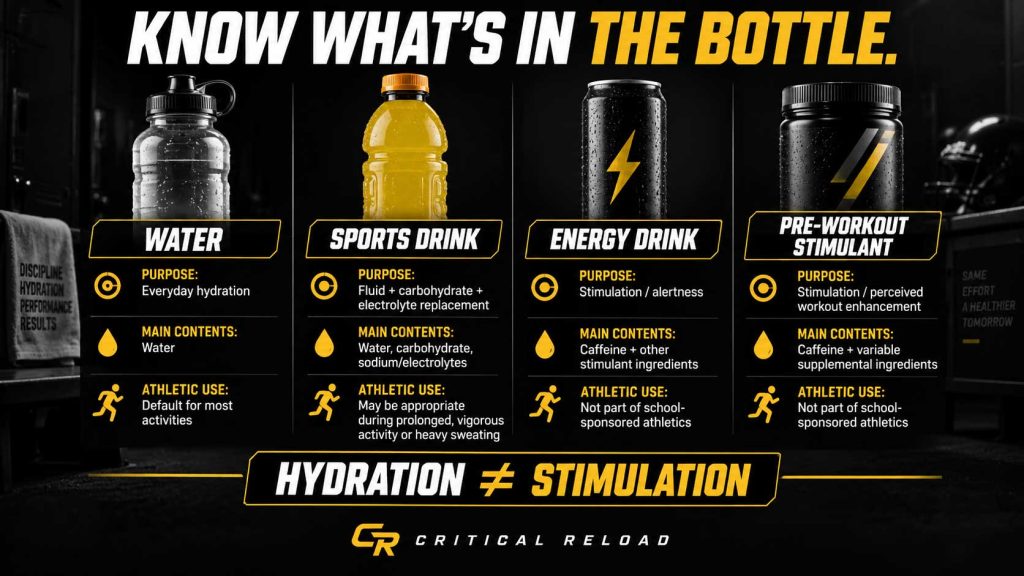
| Water | Everyday hydration | Water | Default beverage for most activities |
| Sports drink | Fluid, carbohydrate, and electrolyte replacement | Water, carbohydrate, sodium and other electrolytes | May be appropriate during prolonged, vigorous activity or heavy sweating |
| Energy drink | Stimulation, alertness, or perceived energy | Added caffeine and potentially other stimulants | Prohibited during school-sponsored athletics |
| Pre-workout stimulant | Stimulation and perceived workout enhancement | Caffeine and variable supplemental ingredients | Prohibited during school-sponsored athletics |
Water should remain the default hydration beverage for most high-school activities. Sports drinks may have a role when exercise is prolonged, vigorous, or accompanied by substantial sweat losses, but that limited role should not be used to legitimize energy drinks (American Academy of Pediatrics, 2011; NFHS Sports Medicine Advisory Committee, 2024).
The Policy Approach
A strong policy should regulate the athletic setting rather than attempt to control every beverage choice a teenager makes away from school. It should clearly apply to possession, use, distribution, promotion, and staff-provided products during all school-sponsored athletic activities.
It should also use proportionate enforcement. The objective is to remove the product, notify the family, educate the athlete, and prevent recurrence, not automatically treat possession of a legal retail beverage as equivalent to alcohol, tobacco, or an illegal drug. Ask staff to enforce the rule consistently with that purpose.
Finally, the rule should cover categories rather than brands. Energy-drink companies constantly release new products, and stimulant products now appear as drinks, shots, powders, gels, gums, and gummies. Use category-based language so the policy stays current and easy to apply.
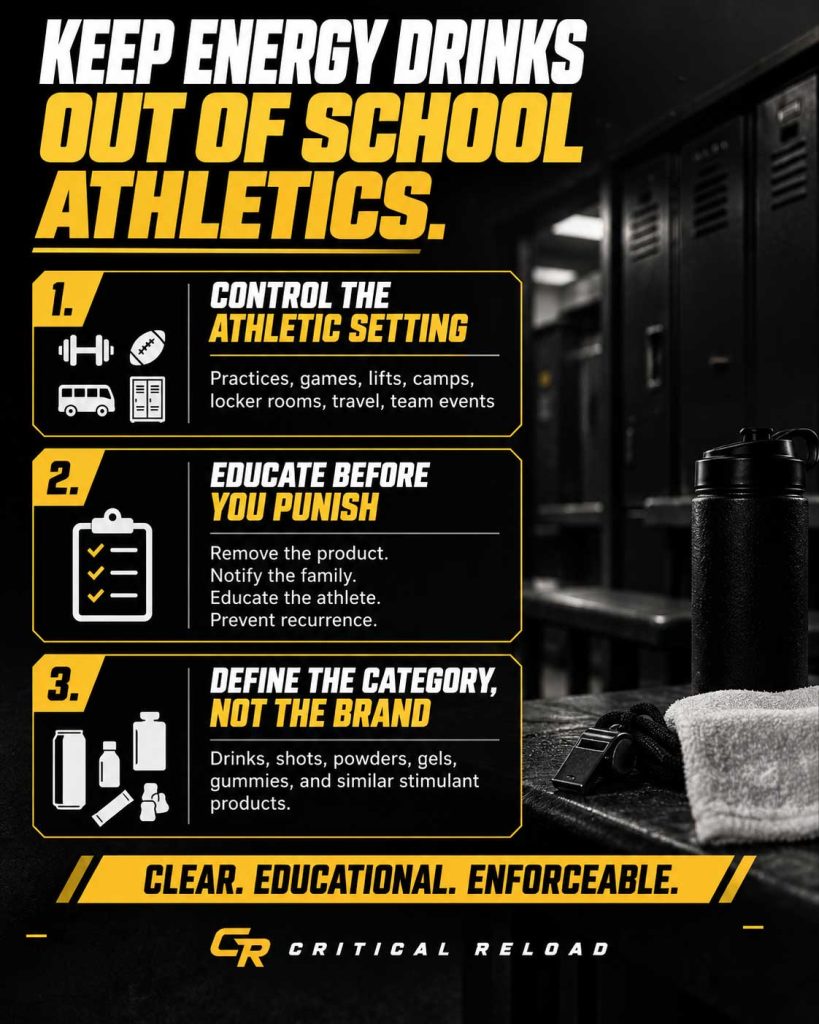
One-Page Student-Athlete Energy Drink Policy
Purpose
This policy protects student-athlete health, supports safe hydration practices, and keeps stimulant-containing products from being normalized or used as performance aids within the school athletics program. Use water first, and keep energy drinks out of school athletics.
Policy
Student-athletes may not possess, consume, distribute, supply, or promote energy drinks during any school-sponsored athletics activity or within an athletics-controlled area. Keep energy drinks out of school athletics.
This restriction applies to:
- Practices and competitions.
- Strength and conditioning sessions.
- Team meetings, camps, clinics, and tournaments.
- Athletic facilities, locker rooms, sidelines, and benches.
- Team transportation and overnight travel.
- Other school-sponsored team activities, whether on or off campus.
Definition
An energy drink is any beverage, liquid shot, powder, concentrate, gel, gummy, or similar product that:
- Is marketed to increase energy, alertness, focus, or performance; and
- Contains added caffeine or another stimulant ingredient.
Stimulant ingredients may include caffeine, guarana, yerba mate, green tea extract, kola nut, or comparable substances. A product does not need to use the words energy drink on its label to fall under this policy.
Not Included
This policy does not prohibit:
- Water.
- Milk or ordinary foods and beverages not marketed as stimulant products.
- Sports drinks used to provide fluid, carbohydrate, and electrolytes when appropriate.
- Medication authorized and administered according to school policy and the student’s healthcare plan.
Address coffee, tea, soda, caffeinated gum, caffeine pills, and dietary supplements through the school’s broader nutrition, supplement, medication, and student-conduct policies. Within athletics, do not supply, recommend, or permit pre-workout stimulants or caffeine pills.
Staff Responsibilities
Coaches, athletic trainers, volunteers, and athletics staff will not purchase, supply, distribute, recommend, advertise, or accept sponsorships involving energy drinks for student-athletes.
Athletics staff will:
- Provide reasonable access to water.
- Teach athletes the difference between sports drinks and energy drinks.
- Refer medical and supplement questions to the athletic trainer, school nurse, physician, or other qualified healthcare professional.
- Apply the policy consistently across teams and competitive levels.
Violations
For a first violation, staff will:
- Direct the student to stop using the product.
- Secure or dispose of the product according to school procedure.
- Document the incident.
- Provide brief education to the student.
- Notify the student’s parent or guardian.
Address repeated violations through the existing athletics code using progressive consequences. The school should avoid categorizing an energy-drink violation as equivalent to possession of alcohol, tobacco, controlled substances, or performance-enhancing drugs unless another policy or substance is involved.
Medical Response
A student experiencing chest pain, fainting, severe palpitations, breathing difficulty, seizure, confusion, severe agitation, or another concerning symptom after consuming a stimulant product will receive an immediate medical assessment. Staff will activate the venue’s emergency action plan and emergency medical services when indicated.
Communication
The policy will be included in the student-athlete handbook and reviewed before each season with athletes, parents or guardians, coaches, athletic trainers, administrators, and relevant volunteers. Booster clubs, vendors, and event partners must comply with the same restrictions during school-sponsored athletic activities.
Administration
The athletic director or designee will interpret this policy in consultation with school administrators, the athletic trainer, school nurse, district medical advisor, and legal counsel. The final policy must comply with applicable board policies, state athletic-association rules, disability accommodations, medication procedures, and student due-process requirements.
Approved by:
Effective date:
Annual review date:
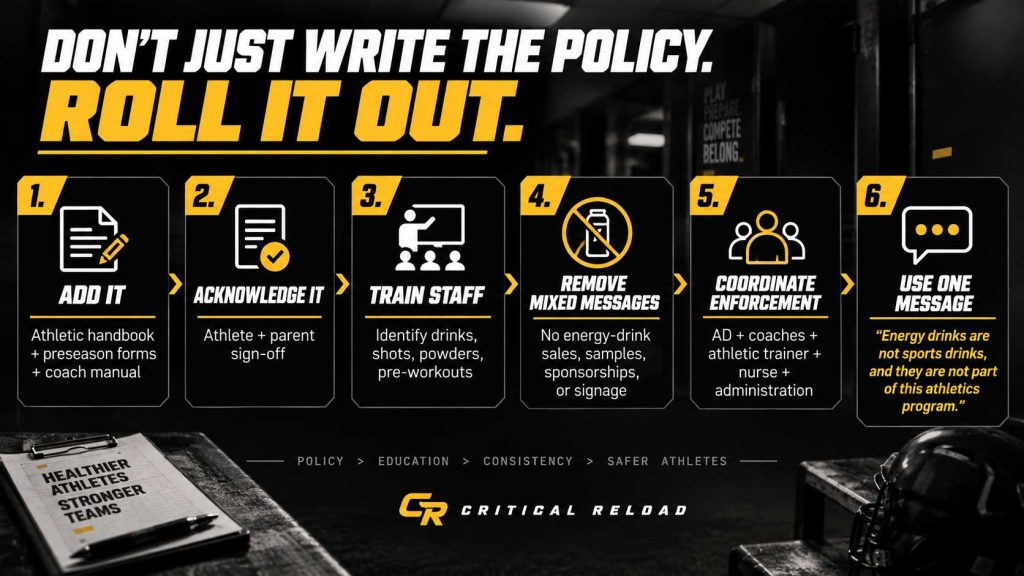
Rollout Checklist
- Add the policy to the athletic handbook, preseason forms, and coach manual.
- Obtain athlete and parent acknowledgment before participation.
- Train coaches to identify energy drinks, shots, stimulant powders, and pre-workout products.
- Remove energy-drink sales, samples, sponsorships, donations, and signage from athletics-controlled settings.
- Coordinate enforcement with administrators, the school nurse, and the athletic trainer.
- Provide water and, when appropriate for the activity, sports drinks.
- Use one consistent message across every team: Energy drinks are not sports drinks, and they are not part of this athletics program.
Evidence in Context
The pediatric experimental evidence demonstrates acute changes in blood pressure, rhythm, and arterial function, but the available trials are small and do not establish the frequency of serious clinical events (Oberhoffer et al., 2022; Mandilaras et al., 2022; Li et al., 2022).
Much of the evidence connecting energy drinks with sleep problems, psychological symptoms, academic difficulties, and risk behaviors is based on observation and cannot prove cause and effect (Khouja et al., 2022; Lake et al., 2024). The most defensible rationale for a school policy is therefore precautionary and practical: energy drinks are unnecessary for hydration, routine performance benefits in adolescents remain uncertain, measurable physiological effects occur at commercially relevant doses, and pediatric and school-sports authorities advise against their use (American Academy of Pediatrics, 2011; Liu et al., 2026; NFHS Sports Medicine Advisory Committee, 2024).
References
- Ajibo, C., Van Griethuysen, A., Visram, S., & Lake, A. A. (2024). Consumption of energy drinks by children and young people: A systematic review examining evidence of physical effects and consumer attitudes. Public Health, 227, 274–281. https://doi.org/10.1016/j.puhe.2023.08.024
- Committee on Nutrition & Council on Sports Medicine and Fitness. (2011). Sports drinks and energy drinks for children and adolescents: Are they appropriate? Pediatrics, 127(6), 1182–1189. https://doi.org/10.1542/peds.2011-0965
- Khouja, C., Kneale, D., Brunton, G., Raine, G., Stansfield, C., Sowden, A., Sutcliffe, K., & Thomas, J. (2022). Consumption and effects of caffeinated energy drinks in young people: An overview of systematic reviews and secondary analysis of UK data to inform policy. BMJ Open, 12(2), e047746. https://doi.org/10.1136/bmjopen-2020-047746
- Li, P., Haas, N. A., Dalla-Pozza, R., Jakob, A., Oberhoffer, F. S., & Mandilaras, G. (2023). Energy drinks and adverse health events in children and adolescents: A literature review. Nutrients, 15(11), 2537. https://doi.org/10.3390/nu15112537
- Li, P., Mandilaras, G., Jakob, A., Dalla-Pozza, R., Haas, N. A., & Oberhoffer, F. S. (2022). Energy drinks and their acute effects on arterial stiffness in healthy children and teenagers: A randomized trial. Journal of Clinical Medicine, 11(8), 2087. https://doi.org/10.3390/jcm11082087
- Lipshultz, S. E., Fisher, S. D., Franco, V. I., Warrick, B. J., Seifert, S. M., & Bronstein, A. C. (2025). Energy drink exposures and trends in children and young adults reported to the National Poison Data System. Progress in Pediatric Cardiology, 78, 101819. https://doi.org/10.1016/j.ppedcard.2025.101819
- Liu, L., Chen, M., Deng, H., Li, H., & Wang, Q. (2026). Acute effects and safety of caffeine ingestion in adolescent athletes: A systematic review and three-level meta-analysis. Nutrients, 18(15), 2520. https://doi.org/10.3390/nu18152520
- Lott, M., Reed, L., Deuman, K., Story, M., Cradock, A. L., & Patel, A. I. (2025). Healthy beverage consumption in school-age children and adolescents: Recommendations from key national health and nutrition organizations: Technical scientific report. Healthy Eating Research. https://healthyeatingresearch.org/wp-content/uploads/2025/01/Technical-Report-FINAL.pdf
- Mandilaras, G., Li, P., Dalla-Pozza, R., Haas, N. A., & Oberhoffer, F. S. (2022). Energy drinks and their acute effects on heart rhythm and electrocardiographic time intervals in healthy children and teenagers: A randomized trial. Cells, 11(3), 498. https://doi.org/10.3390/cells11030498
- National Federation of State High School Associations Sports Medicine Advisory Committee. (2024). Position statement and recommendations for the use of energy drinks by young athletes. National Federation of State High School Associations. https://www.nfhs.org/resources/sports/nfhs-sports-medicine-position-statements-and-guidelines
- Oberhoffer, F. S., Dalla-Pozza, R., Jakob, A., Haas, N. A., Mandilaras, G., & Li, P. (2023). Energy drinks: Effects on pediatric 24-h ambulatory blood pressure monitoring. A randomized trial. Pediatric Research, 94(3), 1172–1179. https://doi.org/10.1038/s41390-023-02598-y
- Oberhoffer, F. S., Li, P., Jakob, A., Dalla-Pozza, R., Haas, N. A., & Mandilaras, G. (2022). Energy drinks: Effects on blood pressure and heart rate in children and teenagers. A randomized trial. Frontiers in Cardiovascular Medicine, 9, 862041. https://doi.org/10.3389/fcvm.2022.862041
- Myers, A. (2026, September 8). Delaware bans energy drink sales at public middle and high schools. WBOC. https://www.wboc.com/news/delaware-bans-energy-drink-sales-at-public-middle-and-high-schools/article_8a78dd90-ce2c-47e9-922d-4fca8b947b95.html