


Labor Day weekend is built around a simple idea: work matters, and the people who do that work deserve to be recognized, valued, and understood.
That makes this an appropriate moment to talk about the STRONG Act.
For strength and conditioning coaches, federal recognition as a distinct occupation would matter. It could help define the profession more clearly, improve workforce data, and strengthen the case that this work is more than an extension of general fitness or sport coaching.
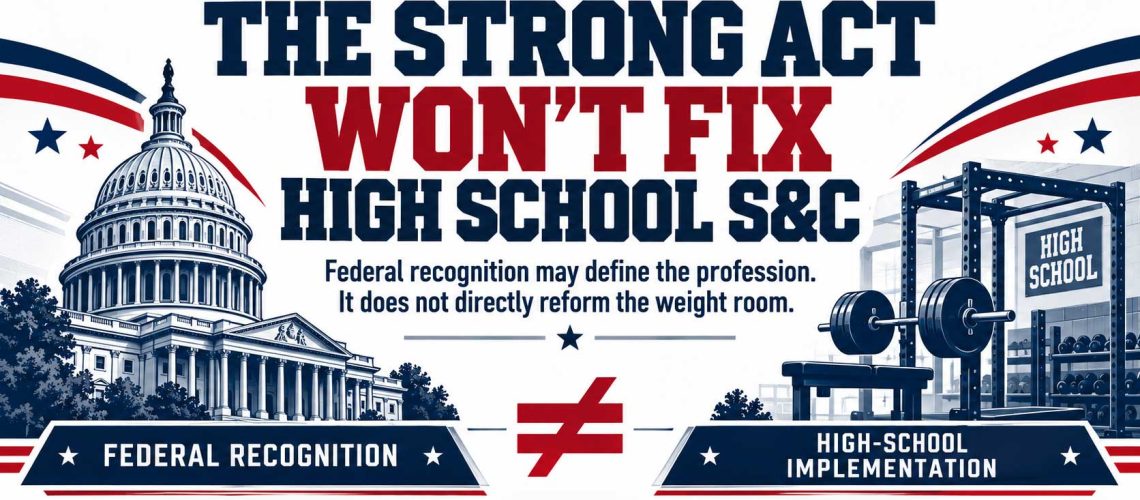
But recognizing a profession and improving the conditions under which that work is performed are not the same thing.
In high schools, the more important questions remain much closer to the weight room: Who is qualified to lead training? What standards govern the program? How are athletes supervised? And what systems are in place to protect them?
So, in the spirit of Labor Day, I support recognizing the work.
I just think we should be equally clear about what recognition does and does not accomplish.
I keep seeing coaches posting about H.R. 9527 and urging everyone to call their representatives. I understand the enthusiasm. But when I look at what the bill actually says, I don’t see how it directly improves high school strength and conditioning.
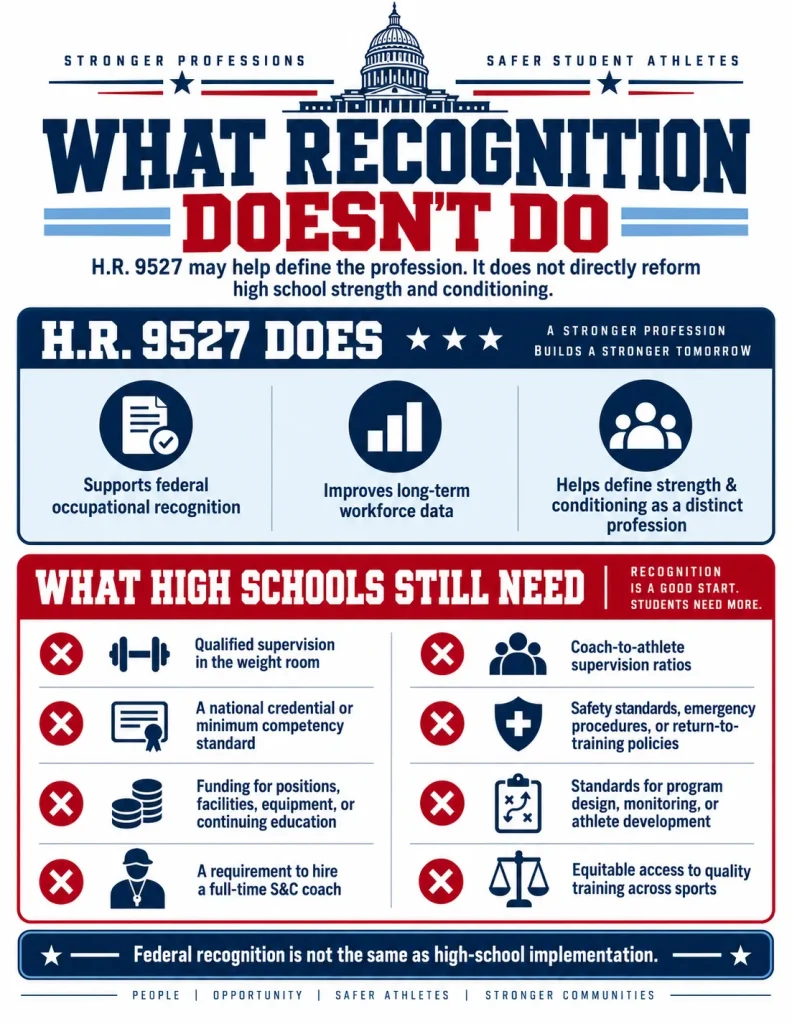
Here is the uncomfortable version: H.R. 9527 would not directly change the day-to-day quality, staffing, safety, funding, certification, or accountability of high school strength and conditioning programs. Its practical purpose is much narrower. It asks the Office of Management and Budget (OMB) to consider a distinct federal Standard Occupational Classification (SOC) code for strength and conditioning coaches.1
That is worth supporting for what it is, but it is not what a lot of the posts are making it out to be.
What the bill actually does
The STRONG Act is formally titled the Support Accurate and Thorough Data Collection and Recognition of Our Nation’s Growing Number of Strength and Conditioning Coaches Act. In practical terms, the bill would direct OMB, during its next revision of the SOC system, to consider creating a separate occupational code for strength and conditioning coaches. Ideally, that code would fall within “Healthcare Practitioners and Technical Occupations.” If OMB chooses not to create the code, it would be required to explain that decision to the relevant congressional committees. The bill authorizes no funding.1
Based on the latest congressional record, Rep. Burgess Owens (R-UT) introduced it on June 29, 2026, and it was referred to the House Committee on Education and the Workforce. It has not passed the House, the Senate, or become law.1
In plain English, this is a federal job-classification and data-recognition bill, not a school-sports reform bill.
Why coaches support it
A dedicated SOC code could have real, long-term value to the profession. For example, better national workforce counts would tell us how many strength and conditioning professionals exist, where they work, what they earn, their education levels, and labor-market demand. It would draw a clearer line between our field and broad catch-all categories like general fitness trainer, sport coach, or recreation worker. It would give colleges, employers, professional associations, researchers, and advocates better data to argue that strength and conditioning is a distinct technical profession. It could also strengthen the case when we lobby state agencies, districts, universities, or legislators for appropriate job descriptions, staffing models, compensation, and qualifications.
That is essentially the case professional groups are making: accurate occupational data can improve workforce planning, education, research, and career development.2
Those are legitimate profession-building goals, and I don’t want to dismiss them. However, they are second- and third-order effects. They are not direct protections for a 15-year-old lifting after school in a high school weight room tomorrow morning.
Why it does little for high schools
For a high school athletic department, this bill does not do the things that actually matter on the floor:
High school need | Does H.R. 9527 address it? |
| Require qualified supervision in the weight room | No |
| Establish a national credential or minimum competency standard | No |
| Fund S&C positions, facilities, equipment, or continuing education | No |
| Require districts to hire a full-time S&C coach | No |
| Set coach-to-athlete supervision ratios | No |
| Create safety standards, emergency procedures, or return-to-training policies | No |
| Require equitable access to quality training across sports | No |
| Establish standards for program design, monitoring, or athlete development | No |
| Improve salary schedules or employment protections directly | No |
| Change state certification/licensure or school hiring rules | No |
Okay, what would legislation that actually touches high-school S&C look like?
A new SOC code may eventually make it easier to say, “This is a recognized occupation with measurable workforce demand.” But it does not compel a superintendent or an athletic director to focus on the role, fund it, or use it well.
There is also a wording limitation worth noting: the bill says OMB must “consider” revising the SOC system. It does not require OMB to create the code at all.1
The high school policy gap
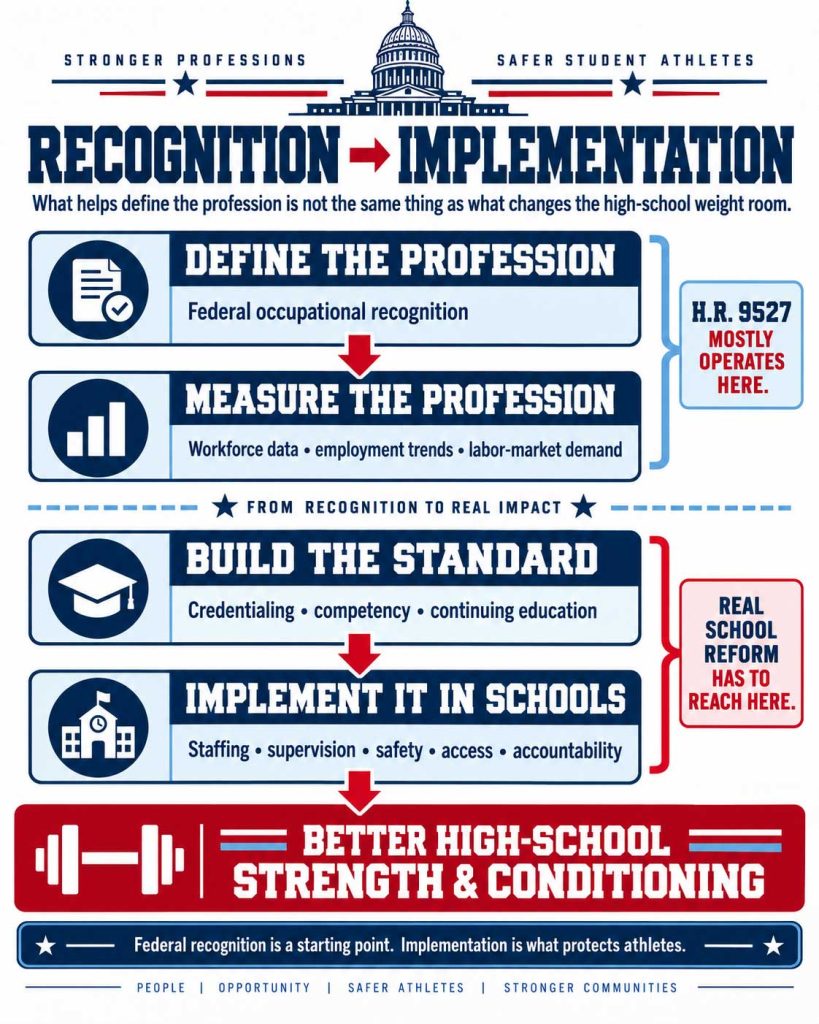
If the goal is genuinely safer, more effective high school strength and conditioning, then the policy conversation has to move from occupational recognition to implementation. In other words, a more directly relevant approach would address who may lead training, how programs are supervised, how they are staffed, how quality is maintained, and how access is protected. That is the policy gap: recognition alone does not define who runs programs, what standards they follow, or how schools are held accountable.
On who may lead training, that means requiring an appropriate, nationally recognized credential for the person primarily responsible for program design and supervision and defining what qualifies as strength and conditioning, rather than leaving a vague “coach-led lifting” loophole. On supervision, it means setting reasonable expectations, prohibiting unsupervised or inadequately supervised training, and requiring emergency action plans, equipment inspection, facility procedures, and documented staff onboarding. On staffing, it means state- or district-level benchmarks, including dedicated S&C positions at larger schools, protected time for program design, athlete monitoring, and joint effort with athletic trainers, sport coaches, administrators, and families. On quality, it means continuing education and renewal, plus clear standards for programming, progression, recordkeeping, athlete screening, and age-appropriate instruction. And on access, it means making sure girls’ teams, non-revenue sports, middle-school transition athletes, and multi-sport athletes get quality training, not only varsity football. Those operational details fill the gap left by recognition alone.
South Carolina offers a much closer example of legislation that could matter operationally. By comparison, Bill 4743 would require public school personnel designated as, or primarily responsible for, leading strength and conditioning workouts to hold a state-approved, nationally recognized credential. It ties athletic supplements to meeting that standard and would take effect July 1, 2027, if enacted. That kind of statute reaches the actual people running high school training sessions. H.R. 9527 does not, because it stops at recognition and data collection instead of setting school-level requirements.
Bottom line
Supporting H.R. 9527 is reasonable if the objective is long-term professional identity, better labor data, and a clearer federal description of the occupation. So make that call. Then ask people to make the phone call.
But it should not be marketed as a meaningful high school strength and conditioning solution on its own. It does not put a qualified coach in a school, improve the lifting environment, ensure appropriate programming, provide a dollar for staffing, or protect an athlete tomorrow morning. That is the standard the debate should meet.
The more honest message would be this: the STRONG Act may help define and measure the profession. By contrast, state policy, district standards, credentialing requirements, staffing investment, and accountable implementation are what actually improve high school strength and conditioning. That is where the real work belongs.
References
- STRONG Act, HR 9527, 119th Cong (2025-2026). Text. Congress.gov. Accessed September 5, 2026. https://www.congress.gov/bill/119th-congress/house-bill/9527/text
- The STRONG Act. National Strength and Conditioning Association. Accessed September 5, 2026. https://www.nsca.com/professional-development/the-strong-act/
- Public School Strength and Conditioning Coaches, HB 4743, SC Gen Assemb, 126th Sess (2025-2026). South Carolina Legislature Online. Accessed September 5, 2026. https://www.scstatehouse.gov/sess126_2025-2026/bills/4743.htm
Official Legislative Sources
1. STRONG Act, H.R. 9527, 119th Congress (2025–2026).
View the current bill status, legislative history, and text on Congress.gov, as well as the official bill document through GovInfo.
View H.R. 9527 on Congress.gov
View the official published bill text on GovInfo
2. South Carolina H. 4743, 126th General Assembly (2025–2026).
View the bill text, sponsors, legislative history, and current status through South Carolina Legislature Online.
View H. 4743 on South Carolina Legislature Online
3. Standard Occupational Classification System, U.S. Bureau of Labor Statistics.
Learn how the federal SOC system classifies occupations and supports workforce data collection.
View the official SOC system
Accessed September 5, 2026.