



Picture two athletes in your 7:00 a.m. lift. Same workout. Same talent. Same program on the whiteboard.
One eats a real breakfast. The other rolls in on fumes.
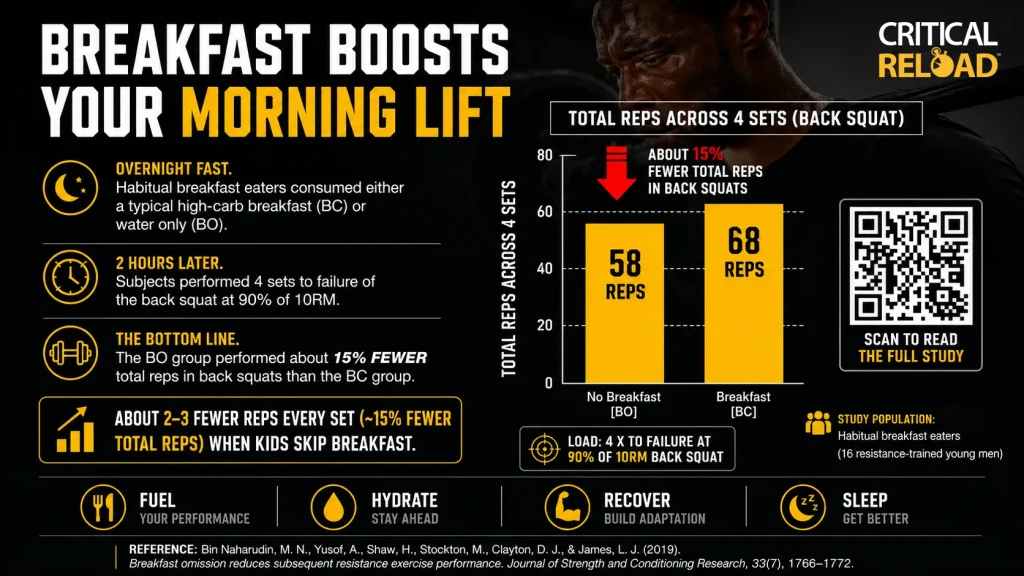
By the end of four sets of squats, the “no breakfast” athlete is down an average of about two to three reps per set across four heavy sets of squats. Not because the program changed. Not because effort changed. Because fuel changed.
That’s the short answer to the question coaches and parents keep asking: is it better to workout after eating or before? When the work is heavy and early, fed beats fasted. And we don’t have to guess about it. Researchers tested exactly this in trained lifters, and the gap showed up on the bar.
What the Study Actually Did
The setup was simple, which is what makes it useful.
Researchers took 16 resistance-trained young men who normally eat breakfast. This was a small, controlled lab study — not a whole-season field trial — but it gives a clear snapshot of what happens to performance set‑by‑set when breakfast is skipped. That detail matters, so hold onto it. These weren’t fasted-training diehards. These were habitual breakfast eaters, the same kind of kids who fill your weight room.
Every lifter did the workout twice, after an overnight fast, in random order:
- One morning, they ate breakfast — a typical high-carb meal, about 1.5 grams of carbohydrate per kilogram of body weight.
- The other morning, they had water only.
Two hours later, they lifted. The test was real work, not a warm-up:
- 4 sets of back squats to failure at 90% of their 10-rep max
- 4 sets of bench press to failure at the same relative load
Same lifter. Same weights. Same rest. The only thing that changed between the two days was whether breakfast was on the table.
What Happened on the Bar
Here’s where it gets practical.
On back squat, the fed athletes completed about 68 total reps across the four sets. Fasted, the same athletes completed about 58. That’s roughly 10 more reps when they ate — roughly two to three more reps per set on average, or somewhere around 15–17% more squat volume at the exact same load.
On bench press, the difference was small. Fed: about 40 reps. Fasted: about 38. Real, but trivial in practice.
They also felt the difference. In the breakfast condition, lifters reported more fullness and less hunger at every check. Skipping breakfast didn’t just cost reps. It made the session harder to attack.
So the signal is clean: for heavy lower-body work in habitual breakfast eaters, eating first added meaningful volume. For lighter or upper-body work, the effect was minor.
That’s the gap. And the only variable was the morning meal.
Why Two or Three Reps Per Set Actually Matters
It’s easy to wave off “a couple reps.” Don’t.
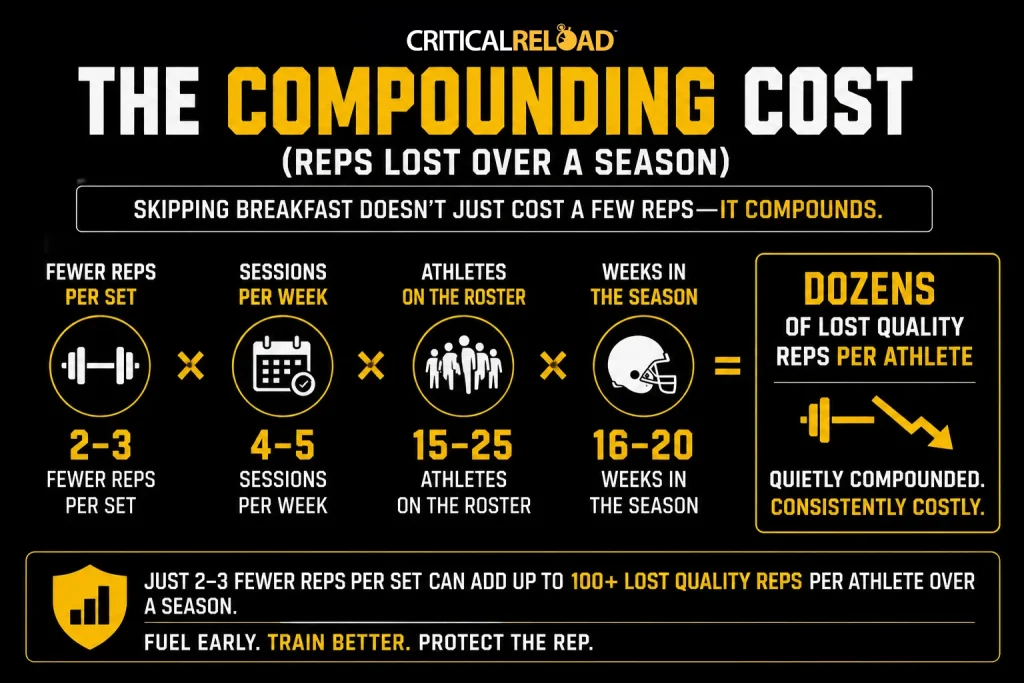
Two to three reps per set is the difference between hitting your prescribed volume and quietly cutting the work short. It’s the difference between a training block that loads the athlete the way you designed and a block that runs slightly under without anyone noticing.
Now stretch it across time. Three or four heavy sessions a week, multiplied by a roomful of athletes, multiplied by a season. That’s dozens of lost reps on your main strength movements per athlete. Over a cycle, that’s real adaptation left on the platform.
Here’s the part most programs miss: the athlete who “never has time for breakfast” is not running your program. They’re running a watered-down version of it. Same whiteboard, different workout.
Is It Better to Workout After Eating or Before for High School and College Athletes?
This is where the lab meets your weight room.
Remember who the study used: habitual breakfast eaters. That’s most of your athletes. They normally eat — until the morning gets hectic, the bus is early, or they sleep through it. On those days, they’re not making a nutrition choice. They’re spotting their competition reps.
A few honest distinctions:
- Heavy morning work benefits most from being fed. Squats, cleans, presses — the high-output stuff is where the fuel gap shows up.
- Light, low-intensity work is more forgiving. An easy aerobic flush at 6 a.m. is a different conversation than a max-effort squat day.
- Frequency compounds the cost. Athletes who train three to five mornings a week can’t afford to give away quality reps every session.
Coaches will debate sets and percentages all day. But if your kids show up on empty, the program on paper is not the program they’re actually running.
Turning the Study Into a Simple Fuel Rule
Information doesn’t change behavior. A repeated standard does. So don’t hand athletes a research summary — give them a rule they can’t misread.
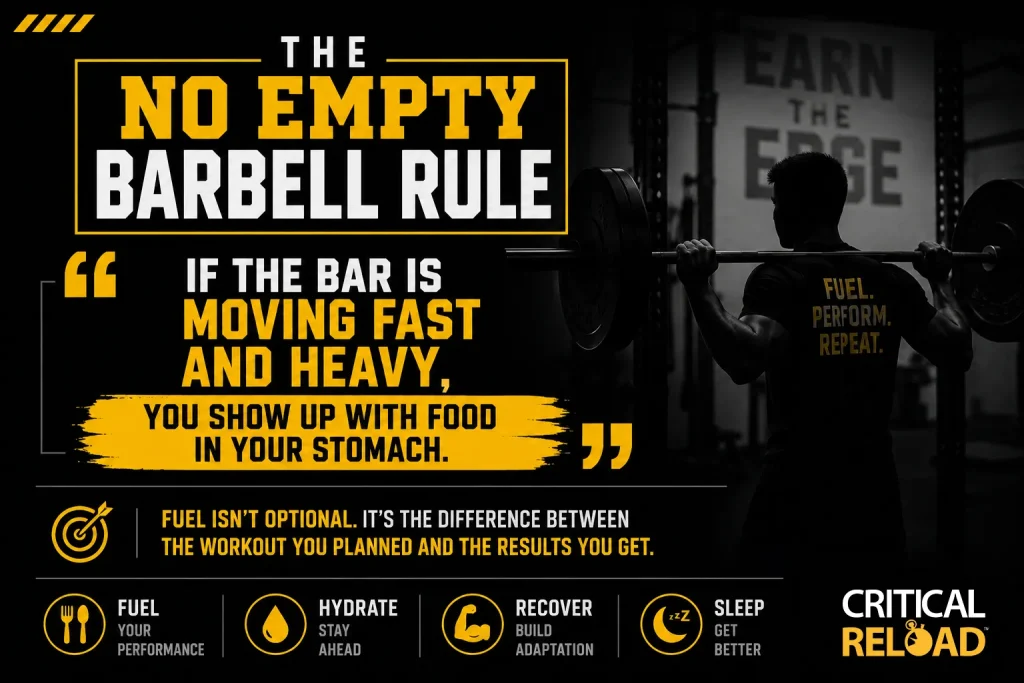
Call it the No Empty Barbell Rule: If the bar is moving fast and heavy, you show up with something in your stomach.
Then make it easy to follow. A workable pre-lift breakfast, eaten 60–90 minutes before training, has three parts:
- A carb anchor: oats, toast, cereal, fruit, a bagel.
- A modest protein source: milk, yogurt, eggs, or a shake.
- Hydration: water on the way in, not just at the rack.
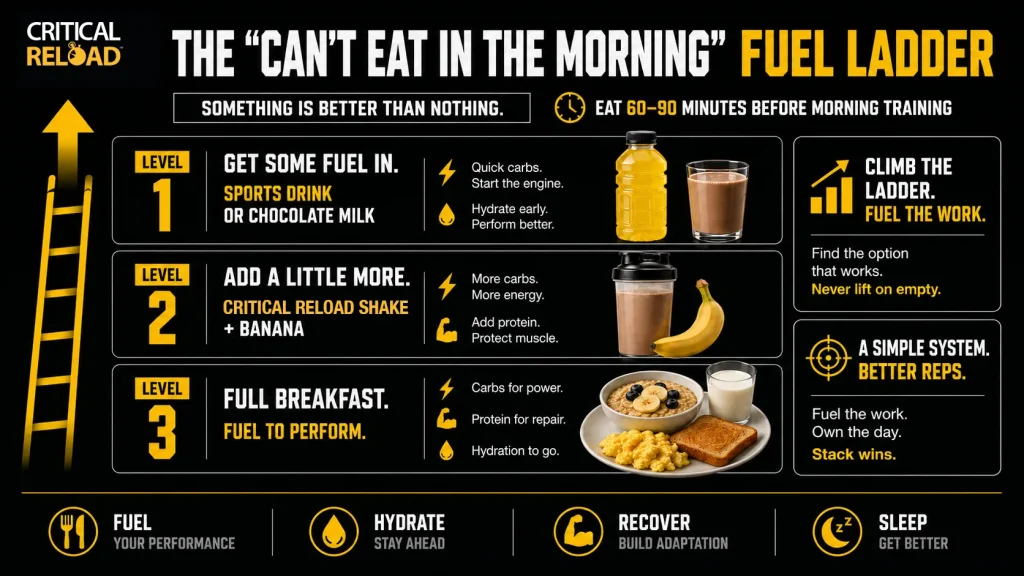
And for the kid who swears they “can’t eat” in the morning, don’t accept zero. Give them a ladder:
- Level 1: a sports drink or chocolate milk.
- Level 2: a liquid shake plus a banana.
- Level 3: a full breakfast.
The principle underneath all of it is what the study showed: more available carbohydrate and energy going in means more quality reps coming out. This isn’t a motivation problem. It’s a fueling system. And a system beats a reminder every time.
This is exactly the gap Critical Reload Shakes is built to close — a simple, school-friendly way to make sure athletes are fueled before early lifts, so the program you wrote is the program they actually run. Critical Reload shakes give schools a simple, supervised way to put fast‑digesting carbs and protein in athletes 30–60 minutes before early lifts.
Talking Points for Parents and ADs
Give the people around your program language they can repeat:
- “When kids skip breakfast, they don’t just feel tired — they complete fewer reps in the weight room.”
- “We invest in racks and platforms. Breakfast is what lets our athletes fully use them.”
- “You can’t build a stronger team on an empty tank.”
Same message, same time, same language. That’s how a fueling habit becomes part of the culture instead of a thing you remind kids about every morning.
The Takeaway
So, is it better to workout after eating or before? For heavy morning training in athletes who normally eat, the research points one direction: eat first. A reasonable carb breakfast two hours out gave trained lifters meaningfully more squat volume at the same load, with no downside.
If you coach morning groups, you don’t need to overhaul your program to capture that. Start by changing breakfast. Build a simple pre-lift fuel plan, hold the standard, and you’ll get more quality reps out of the exact same workout.
Next step: Read our guide on What to Eat Before a Workout for a deeper breakdown of pre-training meals, timing, and easy options for athletes who train early.
Frequently Asked Questions
Is it better to workout after eating or before if I lift in the morning? For heavy morning lifting, it’s better to work out after eating. In trained athletes, a pre-workout breakfast eaten about two hours before training produced more squat volume than lifting fasted, so fueling before lifting is the smarter play when the bar is moving heavy and early.
What should a pre-workout breakfast look like? Keep it simple: a carb anchor like oats, toast, or fruit, a modest protein source like milk, eggs, or a shake, and water. Eat it 60–90 minutes before training so it’s digested and working for you by the time you’re under the bar.
Is it ever better to workout before eating? For light, low-intensity morning work — an easy walk or aerobic flush — training before eating is usually fine. The case for fueling before lifting gets strongest as the session gets heavier, which is why the question “is it better to workout after eating or before” really depends on what the workout demands.
My athlete says they can’t eat that early. What do I do? Don’t accept zero. Use a fuel ladder: a sports drink or chocolate milk at minimum, a shake plus a banana as a middle option, or a full pre-workout breakfast at best. Any fueling before lifting beats showing up on an empty tank.
Reference
Bin Naharudin, M. N., Yusof, A., Shaw, H., Stockton, M., Clayton, D. J., & James, L. J. (2019). Breakfast omission reduces subsequent resistance exercise performance. Journal of Strength and Conditioning Research, 33(7), 1766–1772.