Late-Night Hunger After Practice: Smart Snacks That Help Recovery
Michael Bewley
Late practices are common in competitive sports. However, the question most athletes ask at the end of training is: what to eat after a workout at night without disrupting sleep or excessive calories?
It all depends on who you are, how hard you have been training, and the time of going to bed. Refueling late at night is not about eating “a lot”, but rather having the right amount of protein and carbohydrate for your body and training demands.
Let’s break it down clearly.
Why Eating After a Late Workout Matters
Training longer than 45-60 minutes and particularly in a moderate to high intensity burns your stored glycogen (carbohydrate) and causes muscle protein breakdown. Recovery requires:
Replenishing glycogen
Rhyming muscle protein synthesis (MPS).
Helping to regenerate the immune and hormonal system.
When you do not refuel, the speed of recovery at night is slow. This is even more significant to the increasing number of youth athletes and high-volume competitors.
So yes, if you’re wondering, should I eat after a workout at night? In most cases, yes.
How Much to Eat After a Late-Night Workout
The number of portions is dependent on training load and body weight. These are some evidence-based general targets:
For Most Athletes (Post-Workout Within 60 Minutes)
Protein: 0.25-0.4 g per kg bodyweight
(Average 15-25 g in young people; 20-30 g in adults)
Carbohydrates: 0.5-1 g per kg
(30 to 60g average per moderate to hard session).
When Carbs Matter More
Choose the higher carb range (40–60 g+) if:
Practice lasted ≥60–75 minutes
It was endurance-based (soccer, basketball, swimming)
There’s a morning session the next day
You’re in a double-session training phase
When Protein-Dominant Is Enough
Minimal carbs and 20-30 g protein are adequate when:
The session was a brief strength training
Volume was low
It is not within 24 hours of training again
This clarifies the choice of what to eat after late-night workoutto a great extent – align the snack with the exercise.
Timing: How Close to Bed Can You Eat?
Ideally:
Consume 30-60 minutes after training.
Attempt to complete a meal within 30-90 minutes of sleep.
If you must be asleep within 30 minutes, then choose a liquid variant (shake or smoothie). Liquids are more rapidly digested and have less chance of reflux or stomach indigestion.
For athletes who think of what to eat late at night after a workout, it is more about digestive comfort rather than macro balance.
Practical Recovery Combinations That Hit the Right Macros
The following are realistic combinations which actually strike recovery targets.
Moderate to Hard Practice (≥60 Minutes)
Target: ~20-25 g protein + 40-60 g carbs
Examples:
Banana + 1/2 cup cereal + Greek yogurt (1.5 cups).
Chocolate milk (16–20 oz) + small granola bar
Critical Reload post-workout recovery drink + additional fruit to reach 40–60 g carbs
Turkey sandwich (2 slices of bread + 3-4 oz turkey)
This is a good illustration of a balanced late night post workout meal that assists in the recovery of glycogen.
Short Lift or Light Session
Target: 20-30 g protein + 15-30 g carbs
Examples:
Cottage cheese (1.5 cups) + berries
Protein shake + small apple
Greek yogurt + honey
Lower carb intake works here because glycogen depletion was minimal.
Heavy Training or Two-A-Day Athletes
Target: 25-30 g protein + 60 g carbs
Examples:
A Bowl of rice and lean chicken (3-4 oz)
Oatmeal with protein powder and banana
Critical Reload post-workout recovery drink paired with toast and jam
This is particularly true when answering what to eat after a workout at night, during intensive training.
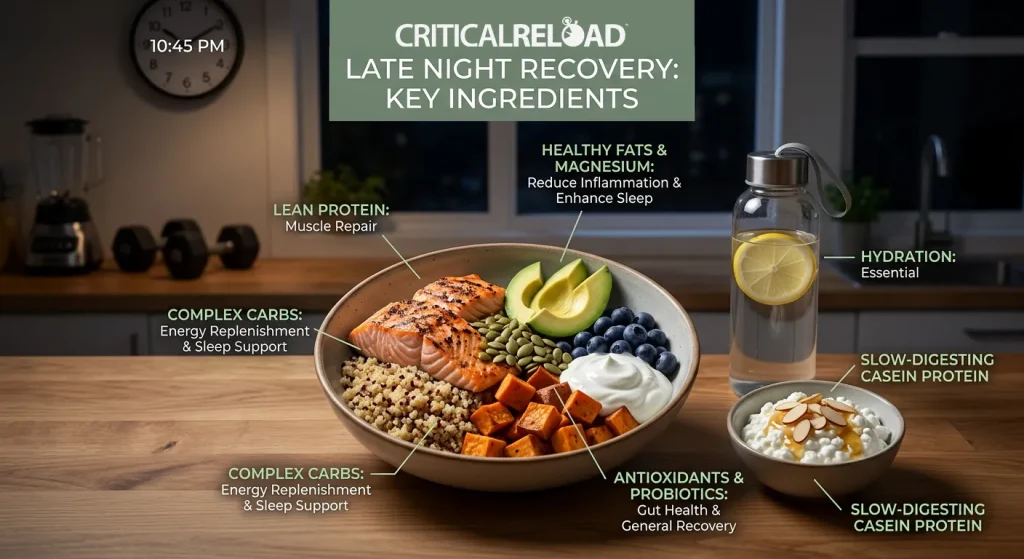
A simple example of what to eat after a workout at night—combining protein, carbohydrates, and healthy fats to support recovery and sleep.
Different Situations to Consider
Youth vs Adult Athletes
Youth athletes (particularly teens) need constant body and muscle replenishment.
Adults can increase intake more strictly depending on the targets of body composition.
If the practice is over 60 minutes, the young athletes should never miss out on the post-workout intake.
Athletes Trying to Gain Mass
Focus on complete macro objectives.
Maintain a higher carb range.
A pre-sleep dose (30-40 g) of casein can be used to aid in growth.
Athletes Managing Weight or in Weight-Class Sports
Keep protein consistent.
Medium amount of carbs, aligned with the intensity of the session.
Avoid excessive caloric intake during the night.
The goal is recovery without excessive caloric surplus.
GI-Sensitive Athletes
If you have reflux or bloating:
Choose low-fat options
Avoid high-fibre cereals
Limit heavy nut butters
Consider lactose-free yogurt.
Take liquid shakes at bedtime.
This holds particular significance in the determination of what to eat after late night workout in case the quality of sleep is poor.
Snacks That Sound Good But Don’t Do Enough
Not all the typical late-night choices do anything meaningful to aid recovery on their own:
Dark chocolate may also affect athletes sensitive to caffeine.
These should be eaten in moderation–but they must not substitute protein + carb recovery intake.
So, Should You Eat After a Workout at Night?
In most cases, yes.
Recovery doesn’t stop because the clock says 9:30 PM. The key is moderating the consumption to:
Bodyweight
Training intensity
Proximity to bedtime
Individual tolerance
For the majority of athletes, the 20-30 g protein and 30-60 g carbohydrate snack consumed within 60 minutes will have a significant positive impact on recovery and will not disrupt sleep.
In its proper form, nighttime eating enhances performance, muscle recovery, hormonal balance and readiness for the next day.
It is not whether to eat or not eat, it is a question of a proper approach to your sport and plan.
And that’s exactly how you answer what to eat after a workout at night in a practical, performance-focused way.
Fuel smarter and recover stronger with Critical Reload, a balanced carb-protein recovery drink designed to help athletes refuel properly after late-night training.
Share this post
Report
There was a problem reporting this post.
Block Member?
Please confirm you want to block this member.
You will no longer be able to:
See blocked member's posts
Mention this member in posts
Invite this member to groups
Message this member
Add this member as a connection
Please note:
This action will also remove this member from your connections and send a report to the site admin.
Please allow a few minutes for this process to complete.