



Most high school coaches track vertical jump. It’s quick, familiar, and gives you a number you can post on the wall. But jump height alone doesn’t tell you how an athlete produces power—and that gap matters more than most programs realize.
The Reactive Strength Index (RSI) fills that gap. It measures how efficiently an athlete can absorb force and immediately redirect it. The formula is simple: jump height divided by ground contact time [Science for Sport, 2025]. An athlete who jumps 20 inches with a ground contact time of 0.25 seconds has an RSI of 2.0. Simple math. But the insight it generates is anything but simple.
What Reactive Strength Index Actually Reveals
RSI quantifies the stretch-shortening cycle—the rapid transition from an eccentric (landing/absorbing) contraction to a concentric (jumping/exploding) one [5]. Every athletic movement depends on it. Sprinting, cutting, rebounding, changing direction—all of them require the body to absorb force fast and redirect it faster.
Most coaches already know that. But they’re still measuring the output without measuring the mechanism. The reactive strength index measures both. It reveals whether your athlete is stiff and elastic like a spring, or slow and muscular like a grinder [3].
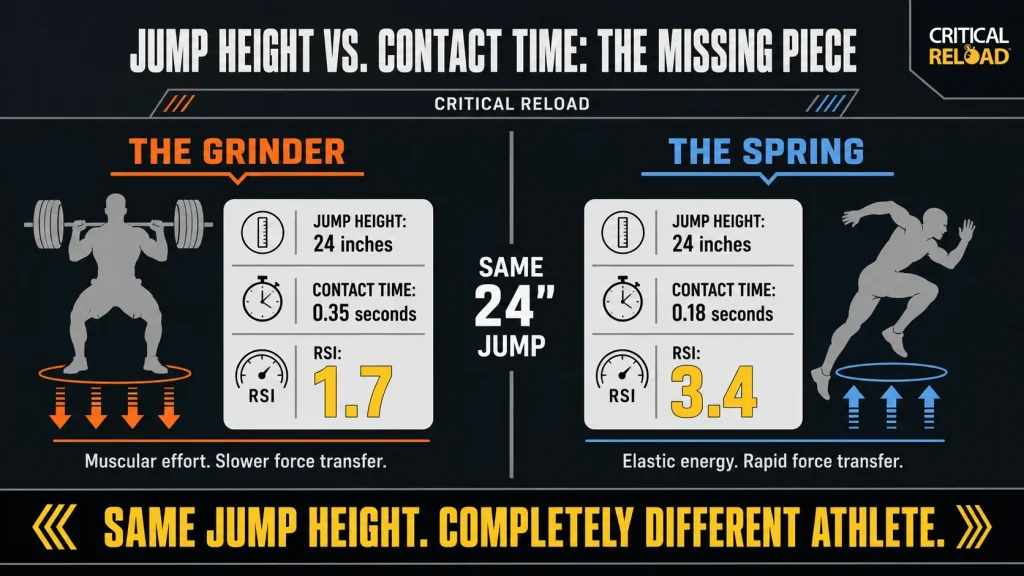
Both types can jump 24 inches. One does it in 0.18 seconds of ground contact—RSI of 3.4. The other takes 0.35 seconds—RSI of 1.7 [6].
In a gym test, they look identical. On the field, they don’t.
Why Vertical Jump Alone Misses the Point
Jump height measures what. RSI measures how. And how is where sport actually lives.
The athlete with RSI = 3.4 stores and releases elastic energy far more efficiently through the muscle-tendon unit. That spring-like quality translates directly to acceleration, change-of-direction speed, and agility [2]. The athlete with RSI = 1.7 is relying more on brute muscular effort—which works, but it’s slower. Most athletic actions happen in fractions of a second. There’s no margin for slow.
That’s not just a performance gap. It’s a training information gap.
Knowing which athlete is which tells you exactly where to direct plyometric work—and where the stretch-shortening cycle is underdeveloped [1]. Without RSI, you’re guessing. With it, you’re programming.
RSI Also Tells You When to Pull Back
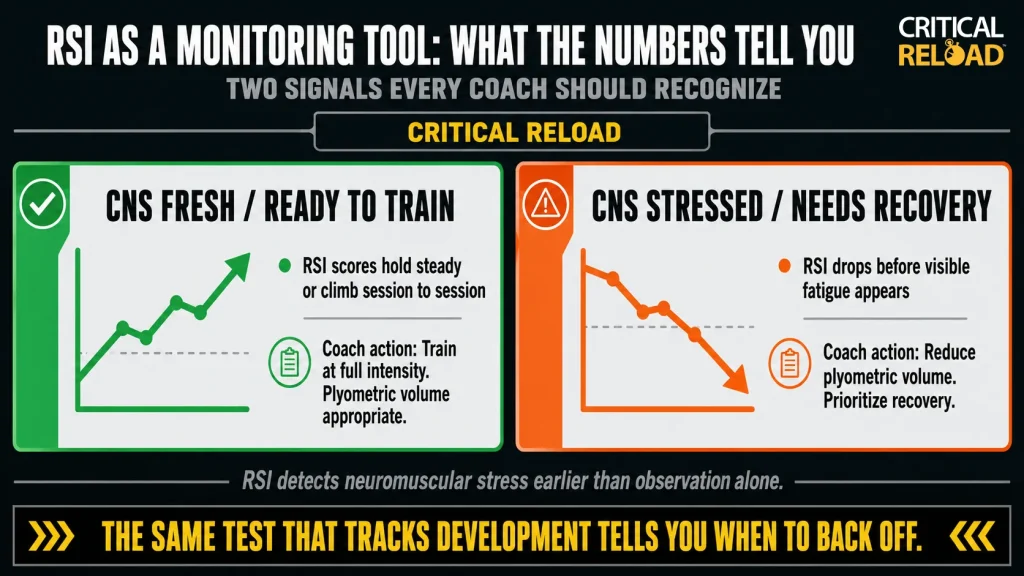
Here’s what most coaches miss: RSI is one of the most sensitive indicators of neuromuscular fatigue available without a force plate.
Small drops in jump height or ground contact time can signal CNS stress before an athlete shows any visible signs of fatigue [9]. If your athletes are testing consistently, RSI becomes a real-time load management tool—not just a development metric.
For high school programs without access to wearables or advanced monitoring systems, that’s a significant upgrade. The same test that tracks development also tells you when an athlete needs recovery. One protocol. Two critical functions.
How to Test Without Expensive Equipment
You do not need force plates.
A jump mat in the $300–500 range measures both flight time and ground contact time and calculates RSI automatically [1]. Validated smartphone apps and IMU-based tools bring the cost down further. The equipment barrier is lower than most coaches think.
The standard protocol is the drop jump. The athlete steps off a 30–45 cm box, lands on both feet, and immediately rebounds into a maximal vertical jump—as high as possible, as fast as possible [7]. Two to three jumps at varying heights to find the optimal score.
For team settings with limited time, the 10-5 repeated hop test works well: 10 consecutive hops, average the best 5 RSI values [4]. No box required. Efficient enough to run with a full roster.
The non-negotiable is consistency. Same protocol, same surface, same instructions—every time. Your data only tracks real development if the testing conditions stay constant.
What to Do with the Numbers
Most coaches think of the reactive strength index as a testing event—something you schedule every few weeks, collect scores, and compare to previous benchmarks. That’s a reasonable starting point. But it’s not where the real value lives.
The more advanced application is embedding RSI directly into training.
Here’s what that looks like in practice: on a Day 1 power session, pair trap bar work with pogo jumps on a Plyomat. The athlete performs a set of trap bar pulls, then immediately flows into pogo jumps while the mat logs RSI in real time. You’re not adding a separate testing block. The testing is the training. The monitoring is built into the session itself.
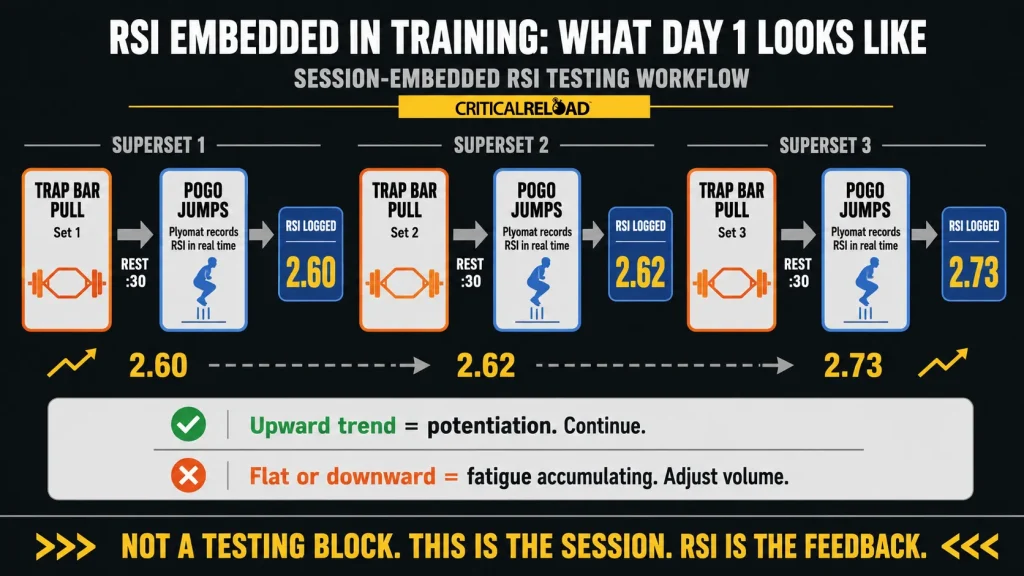
What you get from that structure is something a periodic test can’t give you: a potentiation curve across sets. A typical sequence might look like 2.60 → 2.62 → 2.73 as the nervous system warms up and the athlete begins expressing more elastic quality. That upward arc tells you the athlete is potentiating—the heavy trap bar work is priming the neuromuscular system, and the reactive quality is responding. The athlete isn’t grinding through fatigue. They’re ramping up.
Now flip that picture. If RSI drops set over set—2.70 → 2.61 → 2.54—the session is producing fatigue faster than it’s producing potentiation. That’s a programming signal, not just an observation. You can see it in real time and adjust before the session goes sideways.
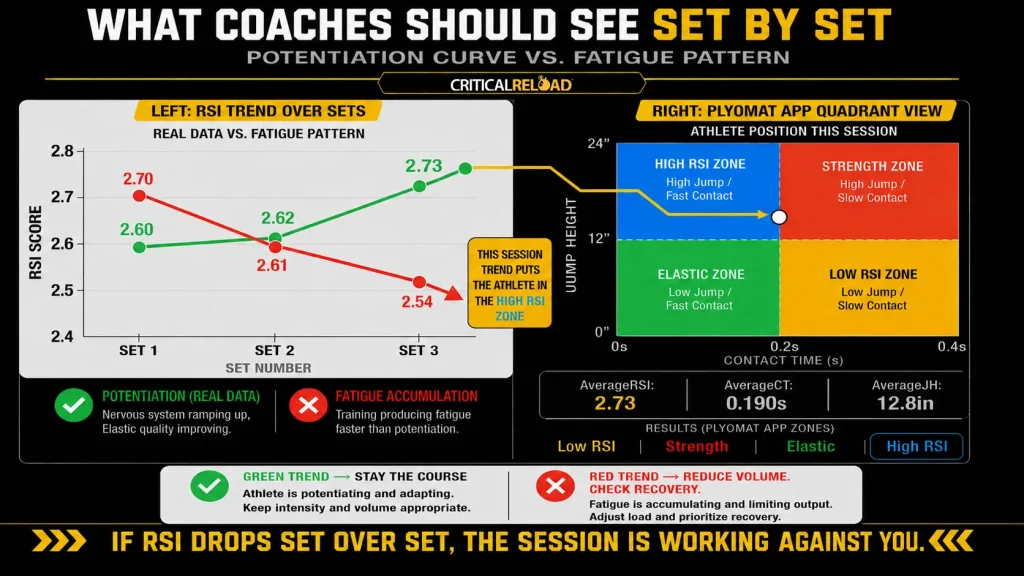
This is the distinction that separates RSI as a training tool from RSI as a monitoring tool. When it’s embedded in the session, it’s both simultaneously.
On a weekly basis, RSI monitoring gives you readiness and recovery data without adding testing overhead. Athletes perform the same pogo protocol at the start of each power session. Over weeks and months, you’re tracking trends in stiffness, elastic response, and power expression—not chasing single-session PRs. A week where RSI is consistently flat or dropping across sessions is information. It tells you something about accumulated load, sleep, stress, or recovery that no subjective wellness check can match.
For most high school athletes, RSI scores fall between 1.0 and 2.5, with athletes in jump-dominant sports or more advanced training phases typically pushing above 2.5 [5]. But norms are far less useful than trends. The score on Monday matters most in relation to the score last Monday, and the set-by-set curve during a session tells you more than either standalone number alone.
The number is not the point. What the number reveals—within a session, across a week, over a training block—is.
Reactive strength index testing doesn’t replace vertical jump testing. It completes it. But more than that, when it’s embedded directly into your power sessions, it stops being a test at all. It becomes part of the system—giving you feedback on whether your athletes are adapting, potentiating, or accumulating fatigue, every time they train.
References
- Dashr Systems. (2025, July 22). RSI – Reactive strength index. https://www.dashrsystems.com/drills/rsi-reactive-strength-index/
- GymAware. (2023, November 20). Reactive strength index (RSI) in sports. https://gymaware.com/reactive-strength-index-rsi-in-sports/
- Harris & Ross. (2025, August 31). Reactive strength index made simple. https://www.harrisandross.co.uk/reactive-strength-index-made-simple/
- O’Toole, K. (n.d.). Understand the reactive strength index and its use in athletic development. EliteTrack. https://www.elitetrack.com/understand-the-reactive-strength-index-and-its-use-in-athletic-development-by-kyle-otoole/
- Output Sports. (n.d.). Guide to reactive strength index – RSI. https://www.outputsports.com/blog/guide-to-reactive-strength-index
- Plyomat. (2023, September 22). Using reactive strength index (RSI) in a team setting. https://plyomat.myshopify.com/blogs/news/using-reactive-strength-index-rsi-in-a-team-setting
- Rypt. (n.d.). How to develop your athletes’ reactive strength index (RSI). https://blog.rypt.app/sandc/how-to-develop-your-athletes-reactive-strength-index-rsi/
- Science for Sport. (2025, March 22). Reactive strength index. https://www.scienceforsport.com/reactive-strength-index/
- Vitruve. (2020, July 14). Reactive strength index and chart – RSI. https://vitruve.fit/blog/rsi/
- Weldon, A., Duncan, M. J., Turner, A., Sampaio, J., Noon, M., Wong, D., & Lai, V. (2022). Practices of strength and conditioning coaches in professional sports: A systematic review. International Journal of Environmental Research and Public Health, 19(9), 5523. https://pmc.ncbi.nlm.nih.gov/articles/PMC9031107/
- Wong, M. A., Lin, C. F., Chen, C. H., Hsu, C. C., Lee, K. T., & Chiu, Y. C. (2023). Effects of plyometric jump training on the reactive strength index in adolescent athletes: A systematic review and meta-analysis. Healthcare, 11(6), 842. https://pmc.ncbi.nlm.nih.gov/articles/PMC10115703/