



Most high school athletes know they should eat before training. The problem is they don’t know when — or what actually happens when they get it wrong.
Here’s the short answer: easy-to-digest carbs as your main fuel, a little protein to support your muscles, and not much fat or fiber close to training. Eat a real meal two to three hours before. Eat a small snack 60 to 90 minutes before. If you only have 30 minutes, top off with something light — a banana, a sports drink, a granola bar.
That’s the whole game.
What you eat before a workout can decide how strong you feel on your last set, how fast you move on your sprint, and how clear your head is in the fourth quarter. Skip it and you train tired. Get it right, and every rep, sprint, and play gets sharper. This is a coach-level guide to fueling for the weight room, field, and court — using real foods from home, the school cafeteria, or a gas station.
Why Your Pre-Workout Fuel Matters
Your body runs on what you give it. Hard training is a withdrawal. And food is the deposit.
Here’s what each macronutrient does:
- Carbs are fast fuel. Bread, rice, fruit, oats, potatoes, pasta. Your muscles and brain burn carbs first for hard efforts.
- Protein is the repair crew. Chicken, eggs, milk, yogurt, beef, beans, fish, whey. It helps you rebuild and grow.
- Fat is slow energy. Nuts, oils, avocado, butter, cheese. Useful daily, but heavy right before training.
- Fiber is gut health. Vegetables, beans, whole grains. Important daily, but too much pre-workout leaves you bloated.
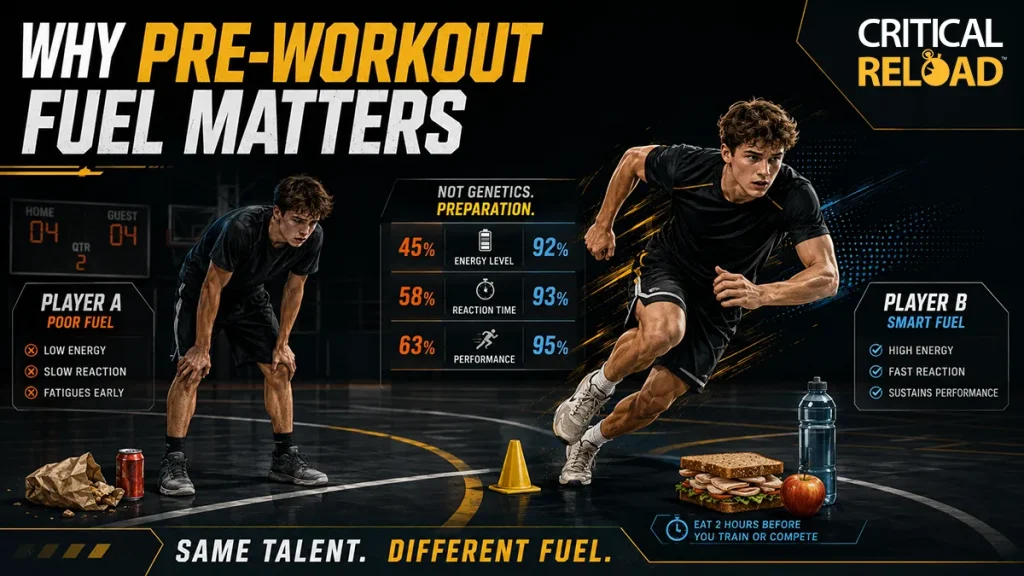
Picture two players. Player A skipped lunch and drank a soda. He’s gassed by the second period. Player B ate a turkey sandwich, fruit, and water two hours before. He’s still moving on the last drill. Same talent. Different fuel.
In fact, pre-workout fuel doesn’t just help you “feel okay.” It changes the score.
How Long Before a Workout Should You Eat?
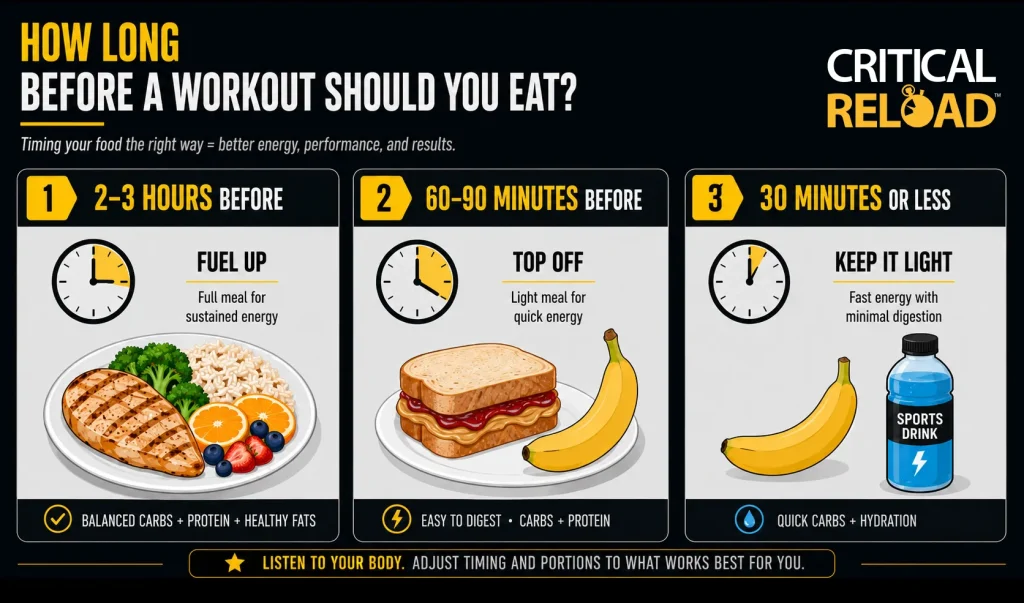
Timing is half the answer. Three windows. And each one has a different rule.
2–3 Hours Before: Eat a Real Meal
This is your big fuel-up. Aim for a balanced plate: a fist of carbs, a palm of protein, and a small amount of fat. Skip the fried, heavy, super-spicy stuff.
Real-world example: Lunch at 11:45, practice at 3:00. Perfect window.
60–90 Minutes Before: Smaller Meal or Big Snack
This is the in-between window. Lighter on fat and fiber. Heavier on quick carbs and a touch of protein. Easy to digest. Don’t overdo it.
Real-world example: 7th period ends at 2:15, lift starts at 3:30. Eat your snack at the start of class.
30 Minutes or Less: Quick Top-Off
Short on time? This is your window. Stick to fast carbs and fluids. Light. Easy. Just enough to wake the body up.
Real-world example: You forgot to eat after school. Practice in 20. Banana, a few sips of a sports drink, water. Go.
So the closer you get to training, the smaller and simpler the food. That’s the rule.
Simple Rules for What to Eat Before a Workout
Skip the complicated meal plan. Start with rules you can actually follow.
- Carbs lead, protein supports. Carbs are the gas. Protein is the maintenance crew. Always pair them, but let carbs do the heavy lifting before training.
- Closer to training means smaller and simpler. So two hours out, eat a meal. Twenty minutes out, grab a snack.
- Hydrate like it’s part of the meal. Drink water with every pre-workout meal or snack. Dehydrated athletes get tired faster and lift less.
- Don’t experiment on game day. Use practice to test foods. Never try something new before a big game or test day.
- Eat something — even if you’re “not hungry.” Nerves kill appetite. A small snack still beats nothing.
- Skip the greasy, heavy, or super-spicy stuff close to training. Fried foods, big helpings of cheese, and spicy sauces sit heavy and slow you down.
Pick one. Start there.
Real-World Pre-Workout Meal and Snack Ideas
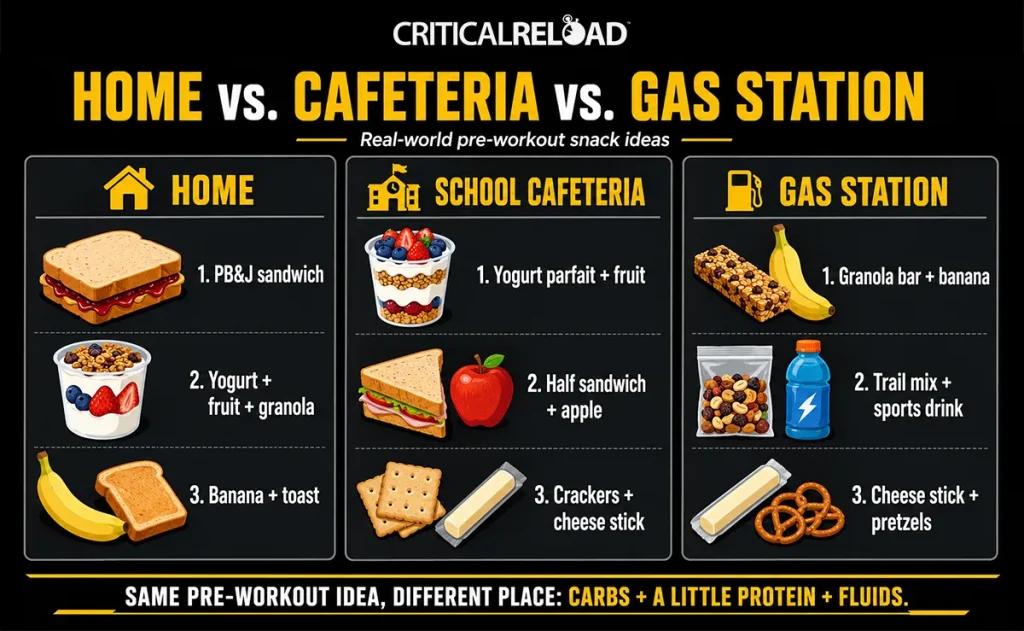
Here are the options. Cheap, simple, and easy to find wherever you actually are.
2–3 Hours Before (Full Meals)
From home:
- Turkey or chicken sandwich, fruit, water
- Rice bowl with chicken, salsa, side of fruit
- Pasta with lean ground beef and milk
- Two eggs, toast, banana, orange juice (great for morning lifts)
From the school cafeteria:
- Chicken sandwich + fruit + milk
- Pasta with meat sauce + roll
- Burrito bowl with rice, beans, chicken
- Hamburger + apple (skip the fries on lift day)
From a gas station:
- Turkey or ham sub
- Pre-made rice and chicken bowl
- Beef jerky + bagel + Gatorade
60–90 Minutes Before (Smaller Meals or Big Snacks)
From home:
- PB&J on wheat bread
- Greek yogurt + granola + berries
- Bowl of cereal with milk and a banana
- Bagel with cream cheese + fruit
From the school cafeteria:
- Yogurt parfait + fruit
- Half a sandwich + apple
- Crackers + cheese stick + grapes
From a gas station:
- Granola bar + banana
- Trail mix (light on nuts) + sports drink
- Cheese stick + pretzels
30 Minutes or Less (Quick Top-Off)
From home:
- Banana
- Toast with honey or jam
- Applesauce pouch
From the school cafeteria:
- Piece of fruit
- Small juice or sports drink
- Animal crackers or pretzels
From a gas station:
- Banana + Gatorade
- Rice crispy treat or fruit snacks
- Small sports drink + pretzel rods
The pattern: two hours out, eat a plate. One hour out, grab a snack with carbs and a touch of protein. Thirty minutes out, simple carbs and fluid. That’s it.
What to Eat Before a Workout to Build Muscle
Your pre-workout fuel is one part of a bigger picture. Three things matter most:
- Show up consistently and lift hard with a real program.
- Eat enough total calories across the day.
- Get enough protein daily — most high school athletes do well at around 0.7–1 gram per pound of bodyweight, spread across meals.
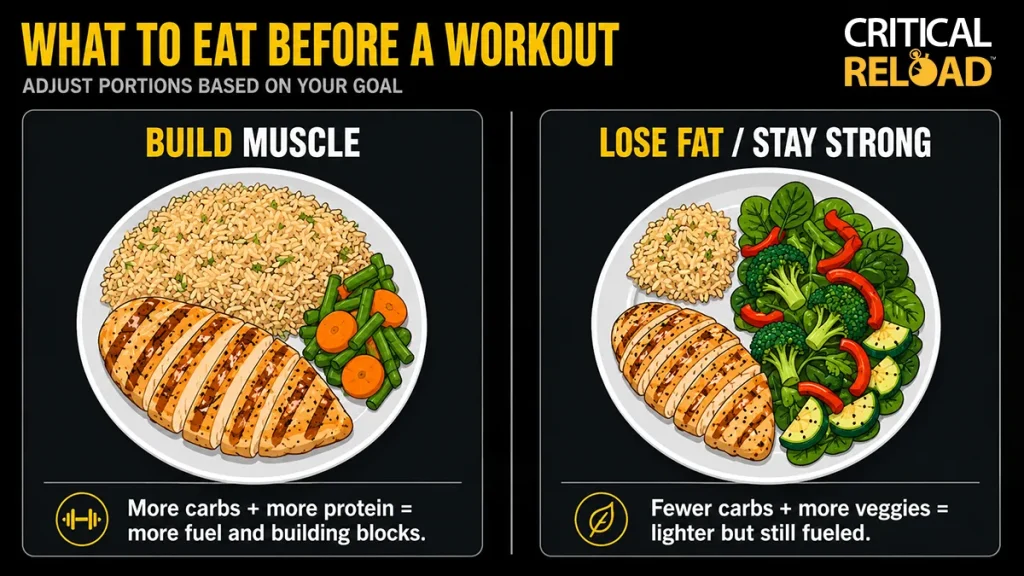
Your pre-lift meal isn’t magic. But it’s also not optional. It’s a big chance to load fuel and start protein flowing into your muscles. Aim for roughly 40–80 grams of carbs and 20–30 grams of protein, ideally 60–120 minutes before lifting.
What that looks like in real food:
- Chicken and rice bowl — palm of chicken, fist of rice, some salsa, water
- Turkey sandwich + fruit + milk — two slices of bread, turkey, banana, glass of milk
- Greek yogurt parfait — one cup of Greek yogurt, granola, berries, drizzle of honey
- Peanut butter and banana sandwich + glass of milk — two slices of bread, PB, banana
- Bagel with cream cheese + scrambled eggs + orange juice — solid pre-morning-lift option
If you struggle to gain weight, drink calories alongside food: milk, chocolate milk, or a shake with milk, banana, peanut butter, and whey. Chocolate milk and fruit work because they give you fast carbs and quality protein together — the two things your body’s looking for after a hard session. If you want that fix in one shaker, Critical Reload Recovery was built for exactly this window..
What to Eat Before a Workout to Lose Weight (Without Losing Strength)
If your goal is to lose weight or drop body fat, start here: fat loss is decided across the full day and week, not in one snack before practice. Don’t skip pre-workout fuel hoping it speeds up fat loss. In fact, it backfires — you train weaker, recover worse, and end up overeating later.
Instead, stay fueled. Keep portions reasonable and the choices clean.
A few “lean and light” pre-workout ideas:
- Greek yogurt + small handful of berries
- Apple + string cheese + a few almonds
- Half a turkey sandwich on whole wheat
- Hard-boiled eggs + a piece of fruit
- Banana + a scoop of whey in water
Quick rules when fat loss is the goal:
- Lean protein at every meal
- Carbs around training, not late at night
- Water and unsweetened tea — limit soda and sugary coffee
- Train fueled, not hungry
Pre-workout fuel is not the place to cut. It’s the place to perform.
Pre-Workout Fuel for Different Types of Training
Not every workout needs the same plate. So adjust to the demand.
Before Strength Training
You need carbs in the tank and a little protein on board. Aim for a meal 2 hours out or a solid snack 60–90 minutes out. And don’t lift on an empty stomach if you can avoid it — your top sets will suffer.
Example: chicken and rice bowl two hours before, water throughout, sip of sports drink during the warm-up.
Before Conditioning, HIIT, or Speed Work
Lean toward easy-to-digest carbs and lighter portions. Heavy meals slow you down on high-intensity work. And skip dairy if it sits weird on you when you sprint.
Example: PB&J 90 minutes before, banana and water 20 minutes before, sports drink during.
Before Games and Tournaments
Eat a familiar meal 3 hours before. Snack 60–90 minutes before. Top off with simple carbs and fluids 20–30 minutes before. Multi-game days? Sip on sports drinks, eat small carb-protein snacks between games — pretzels and jerky, half a turkey sandwich, fruit and granola bars.
Game day is not the time to try new foods. So stick to what’s worked in practice.
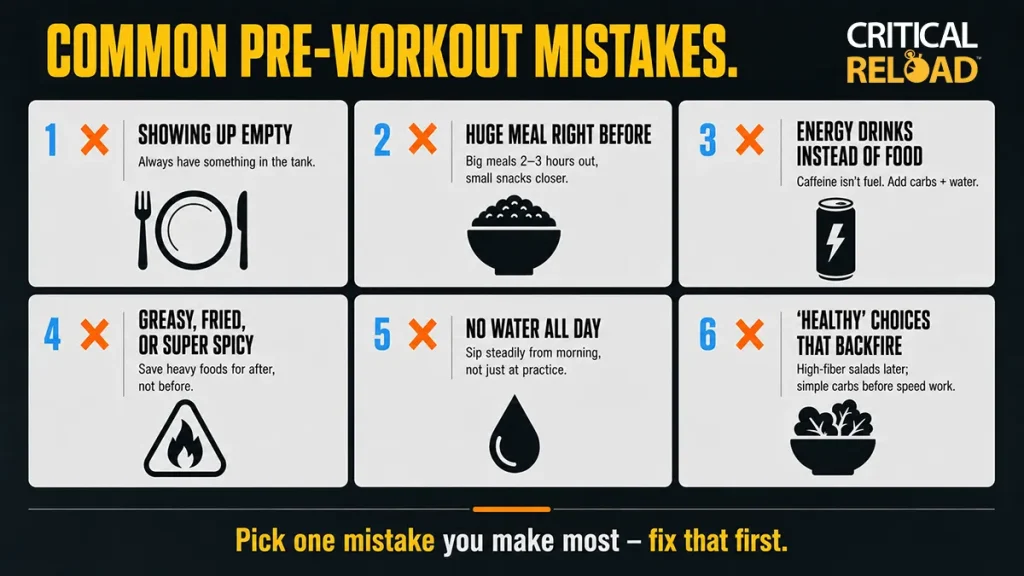
Common Pre-Workout Mistakes High School Athletes Make
- Showing up empty. Skipping lunch and then trying to lift heavy or sprint hard. Always have something in the tank.
- Eating a huge meal too close to training. A full burger combo 30 minutes before practice will sit like a brick. Adjust timing.
- Relying on energy drinks instead of food. Caffeine isn’t fuel. It’s a stimulant. You still need carbs and water underneath it.
- Loading up on greasy, fried, or spicy foods. They take longer to digest and can leave you sluggish or sick.
- Not drinking water all day. You can’t out-snack dehydration. Sip steadily from the time you wake up.
- “Healthy” choices that backfire. Big salads with raw veggies, beans, and fiber are great for dinner — rough one hour before sprints.
But don’t try to fix all six at once. Pick the mistake you make most. Fix that one.
Sample School-Day Fueling Schedule (Example)
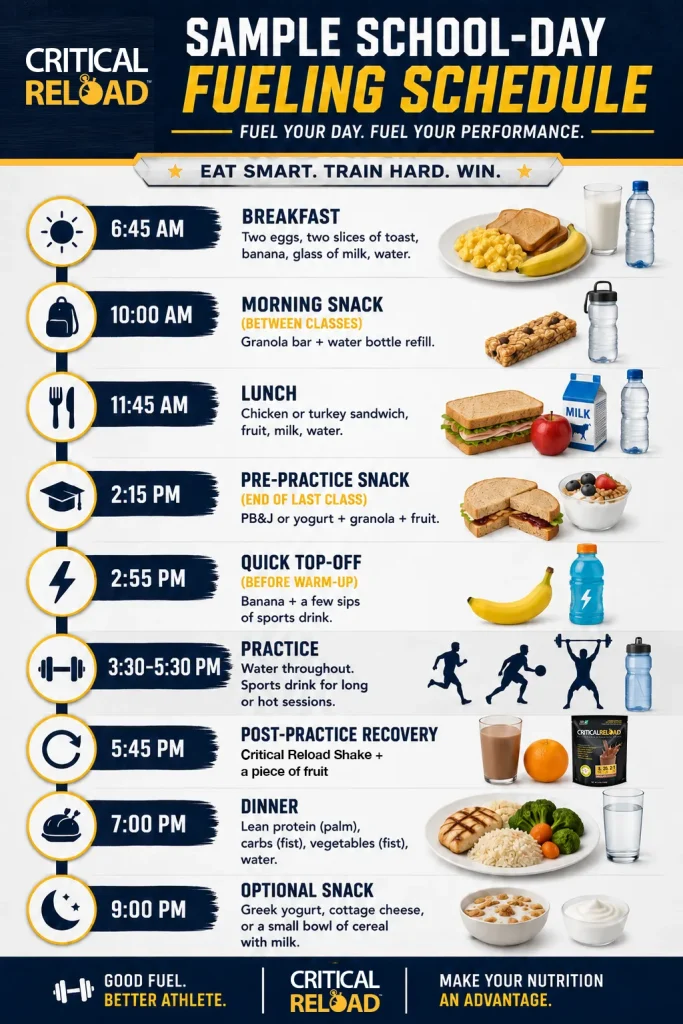
Here’s a simple plan a coach can screenshot and send to the team. Adjust to your schedule.
- 6:45 AM — Breakfast: Two eggs, two slices of toast, banana, glass of milk, water.
- 10:00 AM — Morning snack (between classes): Granola bar + water bottle refill.
- 11:45 AM — Lunch: Chicken or turkey sandwich, fruit, milk, water.
- 2:15 PM — Pre-practice snack (end of last class): PB&J or yogurt + granola + fruit.
- 2:55 PM — Quick top-off (before warm-up): Banana + a few sips of sports drink.
- 3:30–5:30 PM — Practice: Water throughout. Sports drink for long or hot sessions.
- 5:45 PM — Post-practice recovery: Chocolate milk + a piece of fruit.
- 7:00 PM — Dinner: Lean protein (palm), carbs (fist), vegetables (fist), water.
- 9:00 PM — Optional snack: Greek yogurt, cottage cheese, or a small bowl of cereal with milk.
FAQs: What to Eat Before a Workout (High School Edition)
What should I eat before an early morning workout (e.g., 6 AM)?
If you train early, you don’t need a full breakfast. Eat something small and fast 20–30 minutes before: a banana with a few sips of juice, a slice of toast with honey, half a granola bar, or a small glass of milk. Then, eat a real breakfast within an hour after training.
Is it okay to work out on an empty stomach?
For light cardio, sure. But for hard lifts, sprints, or practice — no. Empty-stomach training means lower output, more risk of cramps, and a longer recovery. A small snack still beats nothing.
Can I just have an energy drink before practice?
Technically, you can — but it’s not a meal. Caffeine wakes you up. It doesn’t fuel your muscles. If you’re going to use caffeine, keep it moderate (under 200 mg if you use it at all), and still eat real food underneath it. And never stack multiple energy drinks. That’s a heart problem waiting to happen.
What’s the best pre-workout meal overall?
The best pre-workout meal is one you’ve used before and know works for you. For most high school athletes, a balanced plate of chicken, rice, and fruit two hours out is hard to beat.
What’s a good pre-workout snack for after school?
For after school, keep it simple: PB&J, Greek yogurt and granola, cheese and crackers, or a turkey sandwich half. Pair with water or a small sports drink if practice is long or hot.
What about supplements and “pre-workout” powders?
In most cases, skip them. You’re a high school athlete. You don’t need stimulants stacked on a body still developing. The supplement industry isn’t tightly regulated, and your coach can’t see what’s in those tubs. At this level, real food, water, and sleep beat any powder on the shelf. Eat first. Always.
What should I eat before a workout for energy?
Fast-digesting carbs — bread, rice, fruit, granola bars — paired with a small amount of protein. The timing matters as much as the food. Use the 2-3 hour window for a full meal, the 60–90 minute window for a lighter snack.
How long before a workout should I eat?
Use three simple timing windows. If you have 2–3 hours, eat a real meal with carbs, protein, and a small amount of fat. If you have 60–90 minutes, choose a smaller meal or bigger snack that is easy to digest. If you have 30 minutes or less, keep it simple with quick carbs and fluids, like a banana, sports drink, or water. The closer you get to training, the smaller and simpler your food should be.
One Change This Week
Don’t try to fix everything at once. Pick one change and run it for a week.
Maybe it’s eating something before every practice, even when you’re not hungry. Maybe it’s adding a pre-lift snack 90 minutes out. Maybe it’s swapping the after-school energy drink for a PB&J and water.
Pre-workout fueling is a skill. You practice it like a lift or a sprint. Reps build the habit. And habits build the athlete.
Eat to train. Train to win. Stack the days.
And when practice is done, refuel just as deliberately — a scoop of Critical Reload Recovery gives you the carbs and protein your body needs in the 30 minutes after training, with no guesswork.
Sources
- King, A., Jukic, I., Sousa, C.A., Zinn, C. and Helms, E.R. (2025), Isoenergetic Pre-Exercise Meals Varying in Carbohydrate Similarly Affect Resistance Training Volume Performance Compared to Placebo: A Crossover Trial. Eur J Sport Sci, 25: e12274. https://doi.org/10.1002/ejsc.12274
- Ormsbee, M. J., Bach, C. W., & Baur, D. A. (2014). Pre-exercise nutrition: the role of macronutrients, modified starches and supplements on metabolism and endurance performance. Nutrients, 6(5), 1782–1808. https://doi.org/10.3390/nu6051782
- Rothschild, J. A., Kilding, A. E., Broome, S. C., Stewart, T., Cronin, J. B., & Plews, D. J. (2021). Pre-Exercise Carbohydrate or Protein Ingestion Influences Substrate Oxidation but Not Performance or Hunger Compared with Cycling in the Fasted State. Nutrients, 13(4), 1291. https://doi.org/10.3390/nu13041291
- Rothschild, J. A., Kilding, A. E., & Plews, D. J. (2020). What Should I Eat before Exercise? Pre-Exercise Nutrition and the Response to Endurance Exercise: Current Prospective and Future Directions. Nutrients, 12(11), 3473. https://doi.org/10.3390/nu12113473