




Most athletes think of hydration as just “drinking more water.” However, what separates good athletes from great ones is understanding what electrolytes do and how they fuel every muscle contraction, thought, and heartbeat. (Sawka et al., 2007).
Electrolytes aren’t just a sports drink buzzword. They’re the unsung heroes that make hydration work. Inside Critical Reload Stream, we teach athletes and parents alike how these microscopic minerals drive real-world performance, and how neglecting them can limit progress in strength, recovery, and focus (Casa et al., 2000).
Water Is Life — But It’s What’s In the Water That Counts
In the Critical Reload Stream, we discuss that muscle tissue is nearly 75% water, and the human body as a whole is approximately 60% water (Lu et al., 2023).
Why so much? Water acts as the solvent and transport system of the human body. It:
- Lubricates joints and cushions organs
- Gives cells structure and enables chemical reactions
- Allows blood to carry nutrients throughout the body
- Regulates temperature through sweat (Popkin, D’Anci, & Rosenberg, 2010)
But here’s the secret: the body’s water isn’t pure. It’s filled with electrolytes — minerals like sodium, chloride, potassium, calcium, phosphate, and magnesium — that conduct electricity when dissolved. This electric charge is what powers your cells to perform at their best (Tobias, 2022).

What Electrolytes Do in the Body
Electrolytes exist in every drop of body fluid, controlling how and where energy moves. They’re responsible for four critical athletic functions (Kleiner, 2015):
⚡ 1. Conduct Nerve Impulses
Your brain communicates through electrical signals called nerve impulses. Electrolytes, particularly sodium, create and transmit those impulses by shifting across nerve membranes. Without adequate electrolytes, reaction time slows, coordination falters, and fatigue sets in sooner (Hostrup, 2021).
💪 2. Contract Muscles (Including the Heart)
Every muscle contraction relies on calcium to pull fibers together and magnesium to help them relax again. When electrolytes are low, muscles cramp, spasm, or lose power. This is especially noticeable during late-game fatigue or high-intensity conditioning (Miller et al., 2020).
⚖️ 3. Regulate Fluid Balance
Sodium, potassium, and chloride act as your body’s internal water regulators. They regulate the flow of fluid in and out of cells, maintaining tissue hydration and blood pressure stability. Miss this balance, and dehydration or swelling can follow (Popkin et al., 2010).
🧪 4. Balance pH and Energy Systems
Chloride maintains your blood’s slightly alkaline pH of 7.35–7.45. Meanwhile, electrolytes support the enzymes that produce cellular energy (ATP). Without balance, your body’s internal chemistry struggles — like trying to run a car engine without oil (Coyle, 2004).
What Happens When Electrolytes Are Out of Balance
Electrolyte imbalance is one of the most overlooked threats in sports performance (Sawka et al., 2007).
It can happen due to:
- Heavy sweating in hot conditions
- Poor diet or under-hydration
- Intense training sessions longer than 90 minutes
- Illness (vomiting or diarrhea)
When this happens, athletes may experience:
- Muscle cramps or weakness
- Fatigue or confusion
- Irregular heart rhythms
- Increased risk of soft-tissue injury (Hew-Butler et al., 2015)
In Critical Reload Stream, we show athletes how to see these early signs, and how to respond before they become performance barriers.
We often compare it like this:
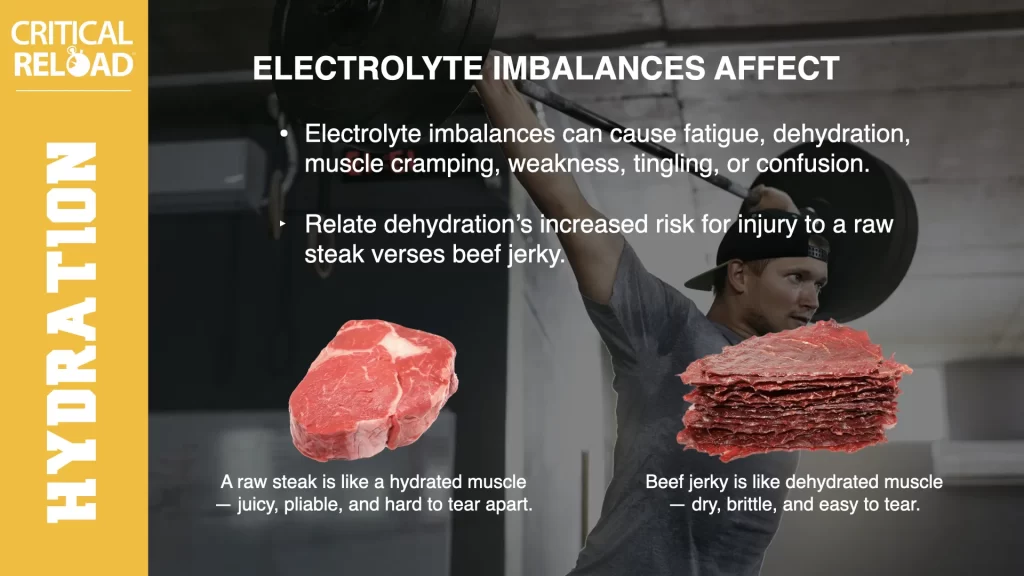
A hydrated muscle is like a raw steak — juicy, pliable, and strong.
A dehydrated muscle is like beef jerky — dry, brittle, and easy to tear.
Sweat, Salt, and Strategy: The Role of Sodium and Chloride
When you sweat, you lose both water and electrolytes. Sodium and chloride are the most abundant in sweat, while potassium, magnesium, and calcium appear in smaller amounts (Baker, 2019).
On average, you lose about 1 gram of sodium per liter of sweat, meaning a runner who sweats 3 liters in one hour can lose up to 5,500 mg of salt (Maughan & Shirreffs, 2010).
This loss doesn’t just make you thirsty; it disrupts electrical signaling and muscle efficiency. That’s why sports drinks and post-workout recovery shakes, such as Critical Reload, include electrolytes: to replace what sweat removes and maintain efficient hydration (Casa et al., 2010).
Sports Drinks vs. Regular Water
It’s a common misconception that electrolyte drinks are “better” than water. In reality, both serve different roles.
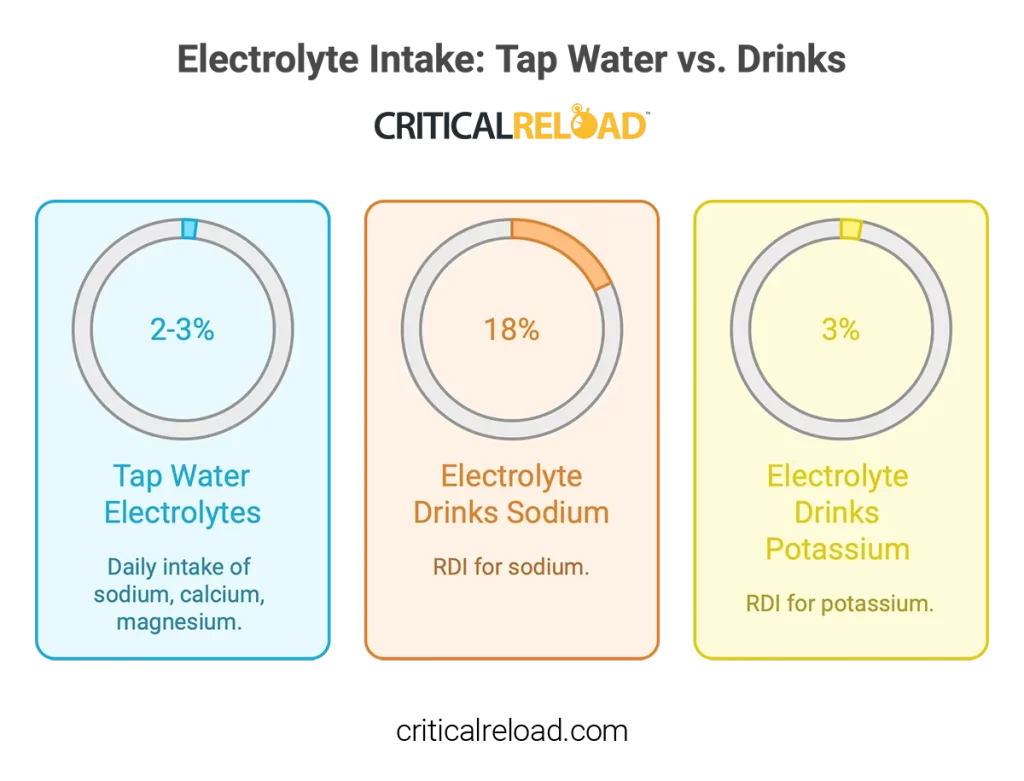
Tap Water: Naturally contains small amounts of electrolytes, roughly 2–3% of the daily recommended intake of sodium, calcium, and magnesium per 34 oz.
Electrolyte drinks contain up to 18% of the RDI for sodium and 3% of the RDI for potassium. However, they often lack magnesium and calcium. (Maughan & Burke, 2021).
So, when training is short or moderate, water is sufficient. As training demands rise, electrolyte-enhanced hydration becomes essential. (Sawka et al., 2007).
Whole-Food Sources of Electrolytes
Athletes don’t have to rely solely on bottled drinks. Whole foods offer rich, natural sources of electrolytes that also deliver vitamins, fiber, and antioxidants (Volpe, 2021).
🧂 Sodium-Rich Foods
Athletes typically need more sodium than sedentary individuals, often 3,000–4,000 mg daily (Kenney et al., 2019).
Good sources: pickles, olives, beans, soups, pretzels, and whole-grain breads.
🥛 Calcium-Rich Foods
Essential for muscle contraction and bone strength (Heaney, 2003).
Good sources: chia seeds, yogurt, milk, leafy greens, fortified orange juice, and canned fish with bones.
🌿 Magnesium-Rich Foods
Supports oxygen uptake and muscle relaxation (Nielsen, 2018).
Good sources: nuts, seeds, spinach, quinoa, edamame, and lentils.
🍌 Potassium-Rich Foods
Vital for nerve communication and heart rhythm (Weaver, 2013).
Good sources: bananas, oranges, potatoes, broccoli, lentils, and salmon.
When to Use Electrolyte Drinks
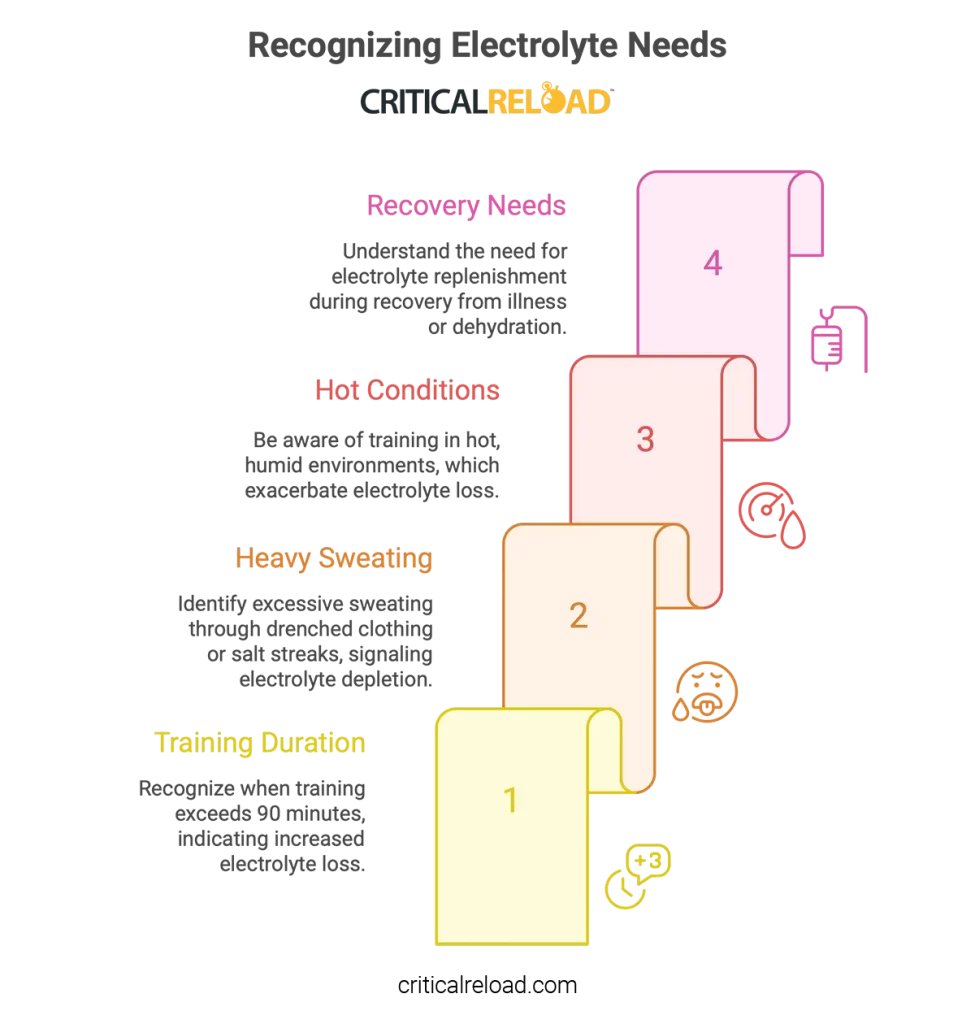
You may need electrolyte-enhanced drinks when:
- Training exceeds 90 minutes
- You sweat heavily (clothing drenched or visible salt streaks)
- You’re training in hot, humid conditions
- You’re recovering from illness or dehydration (Belval et al., 2019)
In Critical Reload Stream, we help athletes personalize these decisions using tools like the Critical Reload Nutrition Calculator, which determines hydration and electrolyte needs based on age, gender, body composition, sport, and training season.
How Critical Reload Stream Brings It All Together
Understanding what electrolytes do is powerful. However, applying that knowledge is what changes habits. That’s where Critical Reload Stream bridges the gap (Volpe, 2021).
- Visual Learning: Short, engaging videos that show how electrolytes, hydration, and performance connect.
- Reflective Prompts: Open-ended questions help athletes relate lessons to their personal experience.
- Coach Integration: Stream equips coaches with ready-to-use talking points and prompts — no grading or prep required.
- Parent Connection: Paired with Fueling Champions, parents learn to support hydration and nutrition at home.
Together, these layers create a 360-degree culture of performance nutrition, where knowledge translates into consistent action across the athlete’s training, recovery, and daily life.
Fuel Smart. Recover Strong. Perform Better.
Electrolytes aren’t just an add-on; they’re the switchboard of your athletic engine. They power nerve communication, muscle function, fluid balance, and recovery — fundamentals of elite performance.
When athletes understand what electrolytes do, they move from reacting to fatigue to preventing it. In contrast, when coaches, parents, and athletes learn together through Critical Reload Stream, they go beyond recovery — they build confidence through knowledge. (Casa et al., 2010).
References
- Baker L. B. (2019). Physiology of sweat gland function: The roles of sweating and sweat composition in human health. Temperature (Austin, Tex.), 6(3), 211–259. https://pubmed.ncbi.nlm.nih.gov/31608304/
- Casa, D. J., Armstrong, L. E., Hillman, S. K., Montain, S. J., Reiff, R. V., Rich, B. S., Roberts, W. O., & Stone, J. A. (2000). National athletic trainers’ association position statement: fluid replacement for athletes. Journal of athletic training, 35(2), 212–224. https://pmc.ncbi.nlm.nih.gov/articles/PMC1323420/
- Coyle E. F. (2004). Fluid and fuel intake during exercise. Journal of sports sciences, 22(1), 39–55. https://pubmed.ncbi.nlm.nih.gov/31608304/
- Heaney R. P. (2003). Long-latency deficiency disease: insights from calcium and vitamin D. The American journal of clinical nutrition, 78(5), 912–919. https://doi.org/10.1093/ajcn/78.5.912.
- Hew-Butler, T., et al. (2015). Statement of the Third International Exercise-Associated Hyponatremia Consensus Development Conference, Carlsbad, California, 2015. Clinical journal of sport medicine : official journal of the Canadian Academy of Sport Medicine, 25(4), 303–320. https://pubmed.ncbi.nlm.nih.gov/26102445/
- Hostrup, M., et al. (2021). Muscle Ionic Shifts During Exercise: Implications for Fatigue and Exercise Performance. Comprehensive Physiology, 11(3), 1895–1959. https://pubmed.ncbi.nlm.nih.gov/34190344/
- Kenney, W. L., et al. (2019). Physiology of Sport and Exercise (7th ed.). Human Kinetics.
- Kleiner, S. M. (2015). Water: An essential but overlooked nutrient. Journal of the American Dietetic Association, 99(2), 200–206.
- https://pubmed.ncbi.nlm.nih.gov/34185846/
- Maughan, R. J., & Burke, L. M. (2021). Sports Nutrition (3rd ed.). Wiley Blackwell.
- Maughan, R. J., & Shirreffs, S. M. (2010). Dehydration and rehydration in competitive sport. Scandinavian Journal of Medicine & Science in Sports, 20(1), 40–47. https://pubmed.ncbi.nlm.nih.gov/21029189/
- Miller, K. C., McDermott, B. P., Yeargin, S. W., Fiol, A., & Schwellnus, M. P. (2022). An Evidence-Based Review of the Pathophysiology, Treatment, and Prevention of Exercise-Associated Muscle Cramps. Journal of athletic training, 57(1), 5–15. https://doi.org/10.4085/1062-6050-0696.20Cramps. Journal of athletic training, 57(1), 5–15.
- Belval, L. N., et al. (2019). Practical Hydration Solutions for Sports. Nutrients, 11(7), 1550. https://pmc.ncbi.nlm.nih.gov/articles/PMC6682880/
- Popkin, B. M., D’Anci, K. E., & Rosenberg, I. H. (2010). Water, hydration, and health. Nutrition reviews, 68(8), 439–458. https://pubmed.ncbi.nlm.nih.gov/20646222/
- Lu, H., Ayers, E., Patel, P., & Mattoo, T. K. (2023). Body water percentage from childhood to old age. Kidney research and clinical practice, 42(3), 340–348. https://pmc.ncbi.nlm.nih.gov/articles/PMC10265208/
- Sawka, M. N., Cheuvront, S. N., & Carter, R., 3rd (2005). Human water needs. Nutrition reviews, 63(6 Pt 2), S30–S39. https://pubmed.ncbi.nlm.nih.gov/16028570/
- Tobias A, Ballard BD, Mohiuddin SS. Physiology, Water Balance. [Updated 2022 Oct 3]. In: StatPearls [Internet]. Treasure Island (FL): StatPearls Publishing; 2025 Jan-. Available from: https://www.ncbi.nlm.nih.gov/books/NBK541059/
- Volpe S. L. (2007). Micronutrient requirements for athletes. Clinics in sports medicine, 26(1), 119–130. https://pubmed.ncbi.nlm.nih.gov/17241918/
- Weaver C. M. (2013). Potassium and health. Advances in nutrition (Bethesda, Md.), 4(3), 368S–77S. https://pubmed.ncbi.nlm.nih.gov/23674806/